
Indian Art
Punjab and Sikh Painting: History, Artists and How to Recognise It

Oct
In short: Punjab painting, often called Sikh painting or the Sikh school, flourished in the 18th and 19th centuries in Lahore, Amritsar, Patiala, Nabha, Kapurthala and Jind. Much of it was made by Pahari artists from the hills who moved to the Sikh courts, especially after Maharaja Ranjit Singh (ruled 1801 to 1839) took the Kangra region. Its favourite subjects are the Sikh Gurus, portraits of rulers and nobles, court scenes, horsemen and, later, everyday life in the Punjab.
Punjab painting is easy to overlook. It came late, after the great Mughal and Rajput schools, and it borrowed freely from both. Yet it has a character of its own: proud horsemen under red parasols, Gurus seated in calm dignity, crowded darbars full of turbans and swords. It is also one of the few Indian traditions where you can watch, within a single lifetime, the shift from hand-painted miniature to European-style portraiture. Here is how that happened, and what to look for.
Where Punjab painting came from
Painting existed in the Punjab long before the Sikh kingdom, and the earliest surviving Sikh works are illustrations in scriptural texts. Accounts of the period describe painters making portraits of the Sikh Gurus as early as the time of Guru Hargobind in Amritsar. Illustrated Janamsakhis, life stories of Guru Nanak, show him travelling with his companions Mardana and Bala, and those images shaped how the Gurus were painted for centuries.
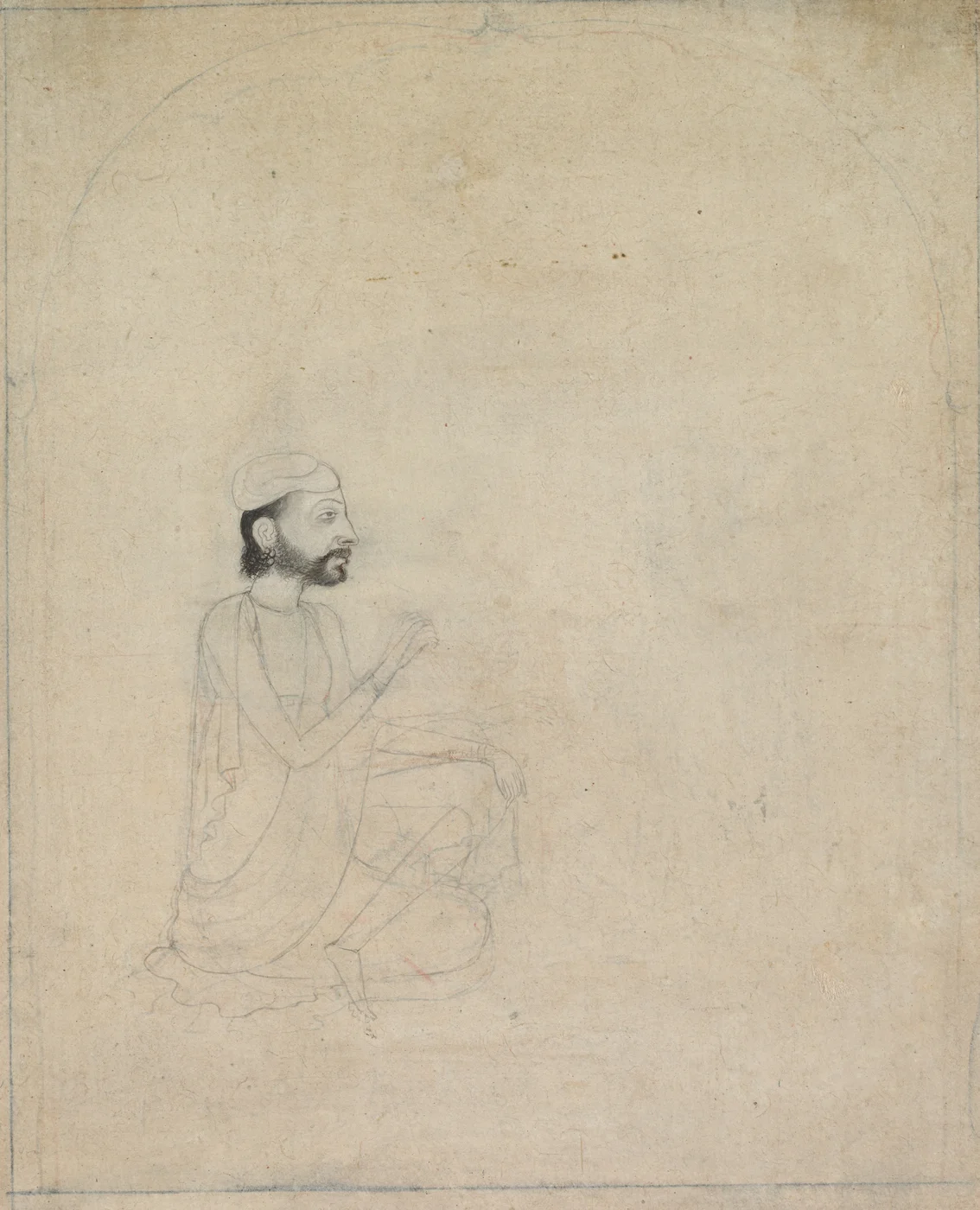
A distinct Sikh school, however, really took shape in the 19th century. The artists were mostly not from the plains. They came from the Pahari hill states, from the declining Mughal workshops of Delhi and from Rajasthan, drawn by new patrons. W. G. Archer, one of the great historians of Indian painting, noted that early in the 19th century Pahari painters were invited to paint portraits of Sikh rulers, nobles and influential families. Records of the Sikh court at Lahore list the names of several Pahari painters working there.
Ranjit Singh and the hill painters
Maharaja Ranjit Singh (1780 to 1839) captured Lahore in 1799, was crowned there at 21, and ruled the Sikh Empire from 1801 until his death. His conquests included the Kangra region, with art centres such as Guler and Sujanpur Tira, and that brought Kangra artists down to the Punjab plains in search of royal patronage. The overlap is so close that Sikh painting is often hard to separate from late Kangra and Guler work. Our guide to Kangra painting tells the hill side of the story.

Interestingly, Ranjit Singh himself is said to have disliked being painted, yet portraits of him were still made by painters from Delhi, Jodhpur and the hills, and by European visitors. His court was a world of portraiture: nobles, generals and visiting dignitaries were drawn and painted. The great general Hari Singh Nalwa owned a collection of paintings, including, according to the traveller Baron von Hügel, one showing Nalwa killing a tiger. Our painting of Hari Singh celebrating with Maharaja Ranjit Singh imagines one of these court scenes in gold and stone colours.
Centres and painter families
Lahore was the capital and the biggest centre, already home to calligraphers, architects and craftsmen from Mughal times. Amritsar, Patiala, Nabha, Kapurthala and Jind also kept painters, and like the Mughals their chiefs maintained workshops. Painting ran in families, called gharanas. The household of Kehar Singh and his nephews Kishan Singh and Bishan Singh is one of the best known, and the Hindu family of Purkhu and Nainsukh’s descendants also worked for Sikh courts. Two kinds of artists are often distinguished: musawirs, who painted people and figures, and naqqash, who specialised in decoration, from floral borders to the murals of shrines.
What Punjab painters painted
The Sikh Gurus
Portraits of the ten Gurus, especially Guru Nanak and Guru Gobind Singh, are the heart of Sikh painting. Guru Gobind Singh is often shown on horseback, a warrior-saint under a royal parasol, as in our Guru Govind Singh painting in the Punjab school.

Rulers, nobles and horsemen
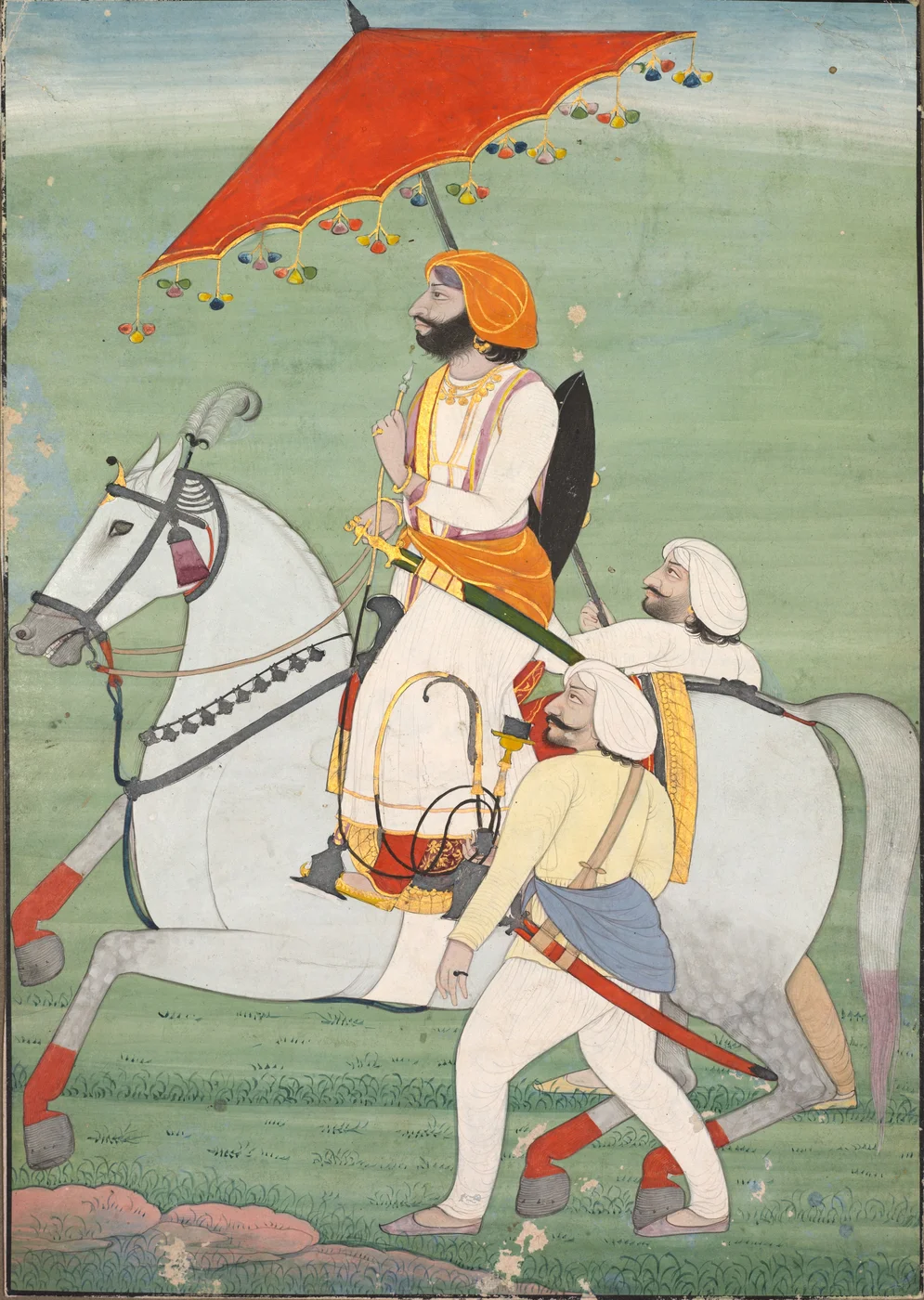
Equestrian portraits were a favourite way to show power: a chief on a richly harnessed horse, attendants on foot, a red parasol held above. Our Sikh on horse and Hari Singh and Ranjit Singh on horse paintings follow this tradition, as does the seated Punjab Sikh portrait.

A closer look: Raja Gulab Singh on horseback
A painting of about 1830 to 1840 in the Cleveland Museum of Art shows how these portraits worked. Raja Gulab Singh of the Dogra dynasty, who served the Sikh state as a military commander before founding the princely state of Jammu and Kashmir in 1846, rides with a hookah carried alongside his horse. The parasol marks him as royalty; the sword and shield, as a warrior. Every detail is a statement of rank, which is exactly what these paintings were for.
The darbar
Court scenes pack dozens of figures into one composition, each turban, beard and sword painted individually. They are records of who mattered at court as much as works of art.
Daily life
Later in the 19th century, painters turned to ordinary people: weavers, carpenters, blacksmiths and village women at work. Our Rural Lifestyle Punjab painting belongs to this gentler strand.

How to recognise a Punjab painting
- Turbans, beards and arms: carefully painted Sikh dress, swords, shields and the long beards of Sikh nobles.
- Pahari grace with a sharper edge: the soft landscapes and fine faces of Kangra and Guler, but with more emphasis on portrait likeness.
- Red parasols and rich harness: signs of royalty, especially in equestrian scenes.
- Architectural settings: terraces, pavilions and white marble, often with flat bands of colour behind.
- Gold: used generously for jewellery, weapons and textiles in court works.
From miniature to Company painting
After about 1830, as contact with Europeans grew, the main influence on Punjab painting shifted from Pahari methods to European ones. Lahore and Amritsar artists began making Company-style paintings, works in a part-Indian, part-European manner, often for British buyers, showing trades, costumes and city life. Over the next century this led to academic portraiture and, in the 20th century, to well-known Punjabi artists such as Sobha Singh and Kirpal Singh, whose paintings of Gurus and Sikh history are widely reproduced today.
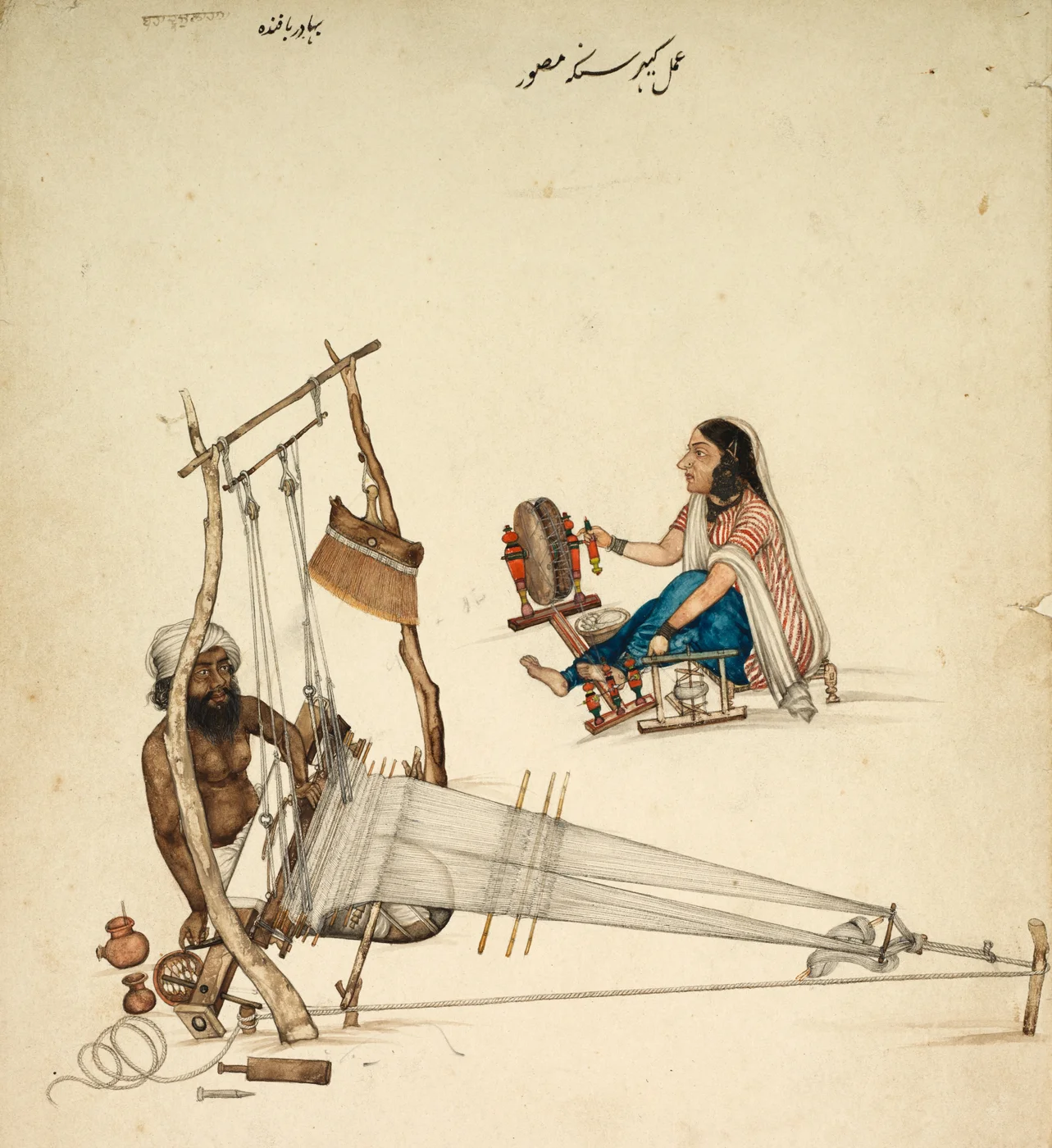
A Company-school painting of weavers and spinners from Amritsar or Lahore, made around 1860 and now in the Cleveland Museum of Art, shows this new interest well: craftsmen work on the ground at simple looms made from branches, painted with a plain, almost documentary eye. Pictures like this were often bought as records of Indian life, and they sit at the meeting point of the miniature tradition and European illustration.
Punjab painting compared with neighbouring schools
| Punjab (Sikh) | Kangra | Mughal | |
|---|---|---|---|
| Peak | 19th century | Late 18th century | 16th to 17th century |
| Main centres | Lahore, Amritsar, Patiala | Guler, Kangra | Agra, Delhi, Lahore |
| Favourite subjects | Gurus, rulers, horsemen, darbars | Radha and Krishna, heroines | Emperors, court life, nature studies |
| Look | Pahari grace plus portrait realism | Soft, lyrical landscapes | Naturalistic, finely modelled |
Read more in our guides to Mughal painting, Pahari painting and Indian miniature painting.
Bringing a Punjab painting home
Punjab paintings suit Sikh and Punjabi homes, gurdwara-inspired prayer corners, and anyone who loves portraiture and history. Equestrian scenes make a strong statement in a living room or study; a Guru portrait belongs in a calm, respectful spot at eye level. Frame works on paper behind glass with a cream mount, and keep them out of direct sun.
All our Punjab paintings are painted by hand on handmade paper in stone colours, several with real gold. Alongside those mentioned above, see the Punjab school miniature, with nobles seated under a red canopy.
Frequently asked questions
Punjab painting, also called Sikh painting, is the miniature and portrait painting of the Punjab in the 18th and 19th centuries, centred on Lahore, Amritsar and Patiala, showing Sikh Gurus, rulers, court scenes and daily life.
Maharaja Ranjit Singh and his court at Lahore were the biggest patrons, along with the chiefs of Patiala, Nabha, Kapurthala and Jind.
Many were Pahari artists from the hill states who moved to the Sikh courts, along with painters from Delhi and Rajasthan and local family workshops such as that of Kehar Singh, Kishan Singh and Bishan Singh.
Portraits of the Sikh Gurus, rulers and nobles, horsemen, court scenes, and later everyday trades and village life.
Very closely. After Ranjit Singh took the Kangra region, Kangra and Guler artists moved to the Punjab plains, so early Sikh painting often looks like late Pahari work with more focus on portraits.
From about 1830, Lahore and Amritsar artists adopted European methods, making part-Indian, part-European pictures of trades, costumes and city life, often for British buyers.
