
Indian Art
Ganesh Painting for Home: Forms, Styles, Placement and Vastu Tips

Oct
In short: A Ganesh painting is one of the most popular choices for Indian homes because Ganesha is the god of beginnings and the remover of obstacles. Choose the form (seated, dancing, child Ganesha or Ganesha with his consorts), then the painting style, and hang it on a clean wall at the entrance, in the living room or in the pooja room, away from bathrooms and clutter. Many families follow traditional Vastu guidance on direction, but the most important thing is an image that feels calm and joyful to you.
Ganesha is everywhere in Indian life: on wedding cards, shop counters, car dashboards and the first page of new account books. So it is natural to want him on your wall too. The choice is wider than it first appears. A Ganesha painted in Kangra style feels nothing like one in Tanjore gold or bold modern acrylic, and the form he takes changes the mood of the picture. This guide helps you choose.
Why Ganesha is the first image in so many homes
Ganesha is honoured as the remover of obstacles and the god of beginnings, so he is worshipped first, before any ceremony, journey or new venture. He is also the patron of learning and the arts. That is why a Ganesha painting is such a common choice for a new home, a new office or a housewarming gift: it marks a fresh start. His great festival, Ganesh Chaturthi, falls in the month of Bhadrapada, usually late August or early September.

Reading a Ganesha painting: the symbols
Once you know the details, every Ganesha painting becomes easier to read:

- Elephant head: the most recognisable feature. One of his names, Gajanana, means “elephant-faced”.
- One tusk: he is called Ekadanta, “the one-tusked”, and is often shown holding the broken tusk in one hand.
- Sweets: a bowl of modaks or laddus, his favourite offering, often with the trunk reaching for one.
- Big belly: another name, Lambodara, refers to it.
- The mouse: his vehicle (vahana), usually sitting at his feet, sometimes nibbling at the sweets.
- Four arms: common in paintings, holding objects such as the tusk, an axe, a noose, a lotus or sweets, with one hand often raised in blessing.
Forms of Ganesha you will see in paintings
Seated Ganesha
The classic, calm form: Ganesha seated on a throne, a lotus or a low platform. Seated images are the most popular for homes and pooja rooms because they feel stable and peaceful.
Dancing Ganesha
Ganesha in motion, one leg raised, belly swinging. Dancing images are joyful and suit living rooms, studios and creative spaces.
Child Ganesha (Bal Ganesha)
Ganesha as a playful child with his sweets and his mouse. These are warm, gentle paintings that work well in family rooms and children’s rooms. Our Lord Ganesh painting in Kangra style shows him seated in a green landscape with his mouse, holding sweets and a lotus.
Ganesha with his consorts
In a popular tradition, Ganesha is linked with Riddhi (prosperity) and Siddhi (spiritual power), personified as two goddesses. Paintings show him enthroned with two female attendants on either side, a grand, formal composition suited to entrances and pooja rooms.

Ganesha on a lotus
The lotus stands for purity. Our Lord Ganesh painting in Rajasthani style shows him rising from a lotus inside a red circle, a simple, striking composition.

Choosing a painting style
| Style | Look | Works well in |
|---|---|---|
| Kangra miniature | Soft colours, gentle landscape, fine detail | Bedrooms, studies, calm living rooms |
| Rajasthani miniature | Bold colour, clear outline, symbolic composition | Living rooms, entrances |
| Tanjore style | Raised relief and gold, enthroned Ganesha | Pooja rooms, formal spaces, gifts |
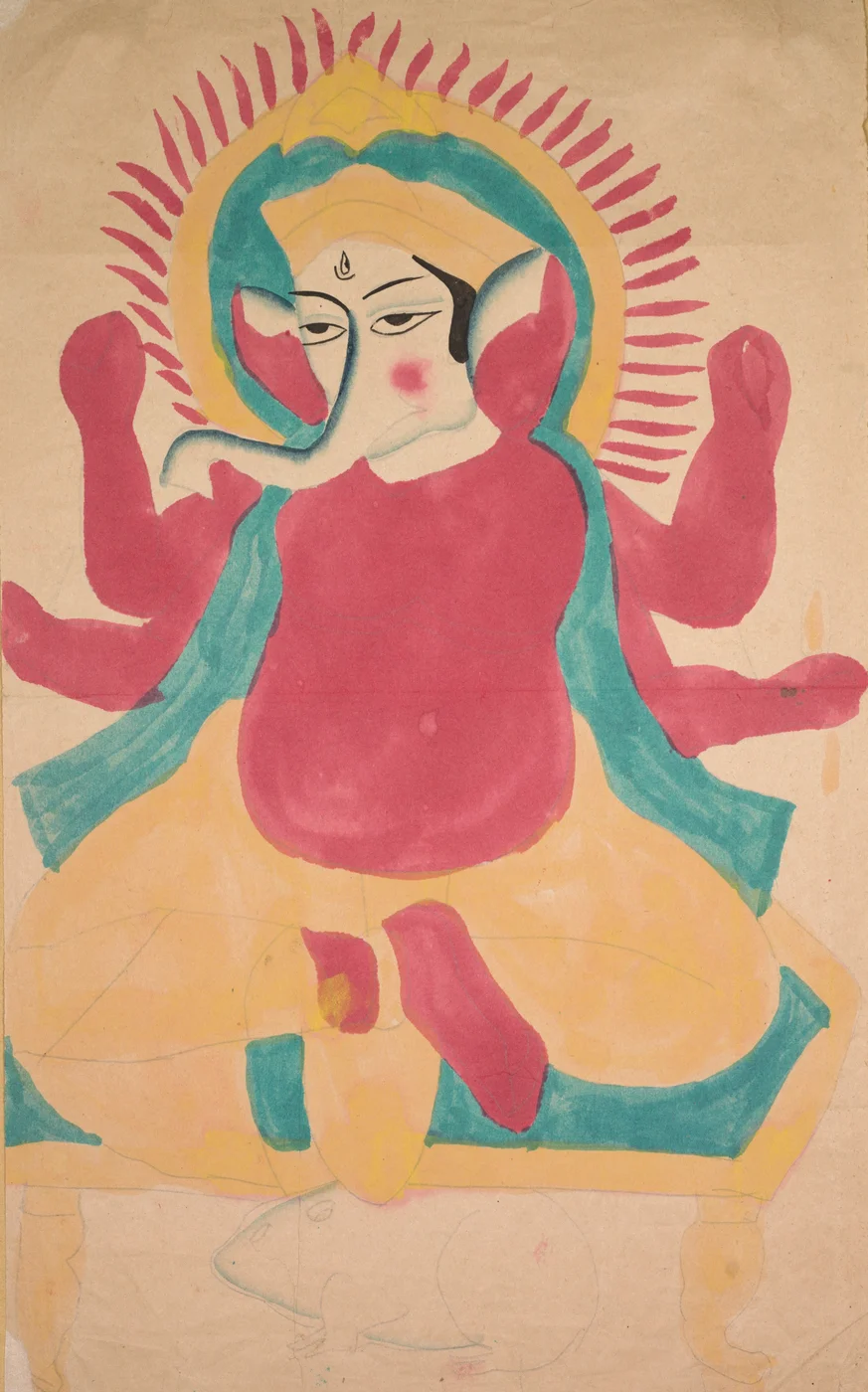
| Kalighat (Bengal) | Bold, sweeping brush lines, simple background | Modern homes with a love of folk art |
| Modern watercolour or acrylic | Expressive colour, close-up face | Contemporary apartments, offices |
Kalighat paintings were made by artists near the Kalighat temple in Kolkata in the 19th century and sold to pilgrims, which is why they are quick and bold. They show how the same god can look completely different from one region to another. Learn more about the traditions in our guides to Kangra painting, Rajasthani painting and Tanjore painting.
Trunk to the left or to the right?
This is one of the most common questions people ask before buying. In popular belief, images with the trunk curving to Ganesha’s left are the usual choice for homes, while a trunk curving to his right is associated with the Siddhi Vinayak form and is often said to call for stricter observance. These are traditions rather than rules, and practices differ between families and regions. If it matters to your household, check the direction in the product photo before you buy; if not, choose the image you find most beautiful.
Where to hang a Ganesh painting

- Entrance: a Ganesha near the entrance welcomes everyone who comes in. Hang it on a clean wall inside the home, at eye level.
- Living room: a medium or large painting can become the focal point, especially a dancing or seated Ganesha.
- Pooja room: seated or enthroned forms, such as Tanjore style, suit a prayer space.
- Office or shop: many business owners keep Ganesha near the entrance or behind the desk as a symbol of good beginnings.
- Places to avoid: bathrooms, under staircases, next to shoe racks, and damp or dusty corners. Many families also prefer not to hang devotional images in bedrooms.
Popular Vastu guidance often suggests the north, north-east or west of the home for Ganesha, and advises against placing him facing south. Advice varies between practitioners, so treat it as tradition rather than a rule. Our guides to Vastu approved paintings and paintings to avoid at home cover the wider picture.
Size and framing
Scale the painting to the wall. A small miniature of about 8 x 12 inches is perfect for a pooja shelf, a study or a narrow wall beside a door; on a large living room wall it can look lost unless it has a generous mount and frame, or is grouped with other works. For a focal point above a sofa or console, choose something larger, or frame a smaller painting with a wide ivory mount so it reads as a bigger piece. Works on paper should always be framed behind glass to protect the colours from dust, smoke from diyas and incense, and the occasional splash during puja.
A Ganesh painting as a gift
Because Ganesha stands for new beginnings, his painting is one of the most appropriate gifts for a housewarming, a wedding, a new baby, or a new shop or office. Choose a seated or child form for a family, an enthroned form for a pooja room, and a modern piece for a young couple’s apartment. Our guide to wedding gift paintings has more ideas.
Our hand-painted Ganesh paintings
Every Ganesh painting at Artshaili is painted by hand on handmade paper:
- Ganesh ji watercolour painting, a vivid modern close-up, about 8.3 x 11.7 inches, ₹8,999.
- Lord Ganesh in Rajasthani style, rising from a lotus, about 8 x 8 inches, ₹15,999.
- Lord Ganesh in Kangra style, playful and gentle, 8 x 12 inches, ₹29,999.
- Lord Ganesh in Tanjore style and the Lord Ganesha emboss painting, enthroned in real gold, 18 x 13 inches, ₹90,000 each.
Most can be ordered with or without a frame. Looking for a different size or form? Contact us about a custom Ganesh painting.
Frequently asked questions
Yes. Ganesha is the god of beginnings and remover of obstacles, and his painting is one of the most popular devotional images for Indian homes.
At the entrance, in the living room or in the pooja room, on a clean wall at eye level. Avoid bathrooms, under staircases and next to shoe racks.
Popular Vastu guidance often suggests the north, north-east or west of the home and advises against facing south. Advice varies, so treat it as traditional guidance.
In popular belief, a trunk curving to Ganesha’s left is the usual choice for homes, while a right-curving trunk is linked with the Siddhi Vinayak form and stricter observance. Practices differ between families.
A seated or child Ganesha in soft colours is a popular choice for a new home, as it feels calm and welcoming.
Yes. Because Ganesha stands for new beginnings, a Ganesh painting is one of the most traditional and meaningful housewarming gifts.
