
Indian Art
Indian Miniature Painting: Meaning, History, Materials and the Main Schools

Oct
In short: An Indian miniature painting is a small, highly detailed painting made to be held in the hand and looked at closely, usually painted on handmade paper with mineral colours and gold. The tradition runs from Buddhist and Jain manuscripts (10th to 15th century) through the Mughal, Rajput, Pahari and Deccan courts (16th to 19th century), and it is still practised by artists in Rajasthan and the hills today.
Most people meet Indian miniature painting in a museum case or a shop in Udaipur or Jaipur and come away with the same question: why is something so detailed called “miniature”, and how do you tell one school from another? This guide answers both, and then gets practical about buying one for your own wall.
What “miniature” actually means
The word has nothing to do with size at first. It comes from the Latin miniare, “to colour with minium”, the red lead pigment that European scribes used to decorate manuscripts. Because those illustrations were small, “miniature” slowly came to mean “small picture”, and the term was later applied to Indian and Persian book painting too.

In the Indian context, a miniature is best understood as a painting made for close, private viewing. It was turned in the hands, passed around a court gathering, or kept in an album or a bundle of loose folios wrapped in cloth. Most are smaller than an A4 sheet, but not all: the pages of the Hamzanama made for Emperor Akbar were painted on cotton cloth at roughly 20 by 27 inches. What unites them is the way of looking. Every face, leaf and textile pattern is painted to reward someone standing a few inches away.
From palm leaves to royal workshops
Buddhist and Jain manuscripts
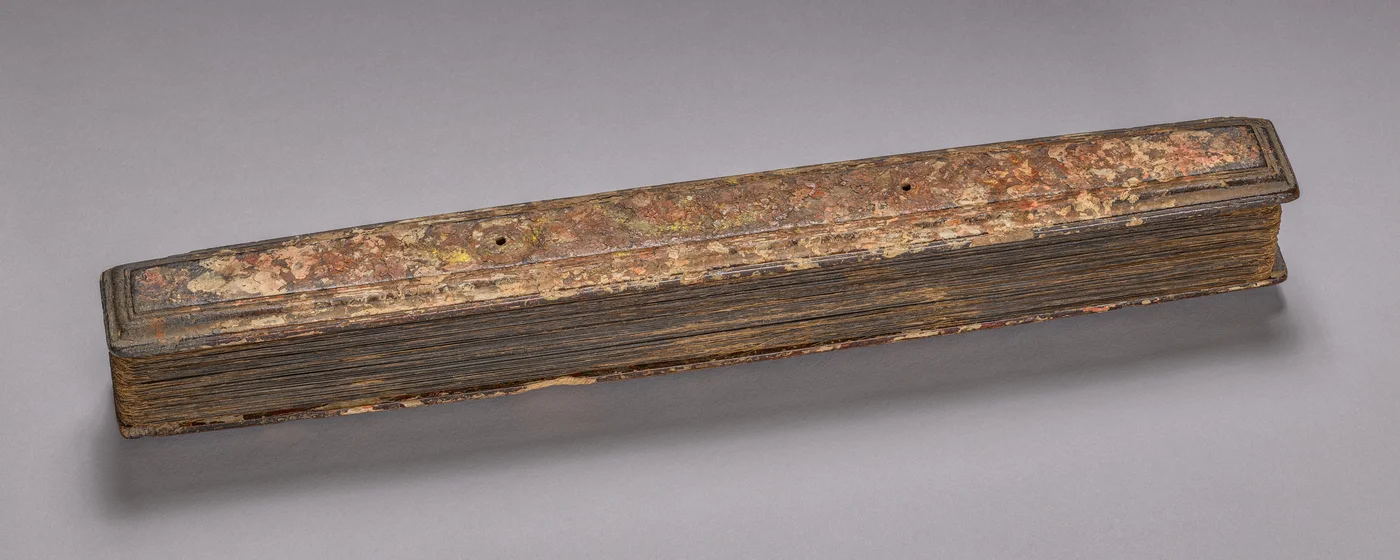
The oldest surviving Indian miniatures are small illustrations in Buddhist palm-leaf manuscripts from eastern India under the Pala dynasty. One of the earliest dated examples, a copy of the Perfection of Wisdom (Ashtasahasrika Prajnaparamita) from 985 CE, is in Cambridge University Library. In western India, Jain monasteries commissioned illustrated texts such as the Kalpa-sutra from around the 12th century, first on palm leaf and later on paper, with flat red grounds, angular figures and a distinctive protruding far eye.
The Mughal court
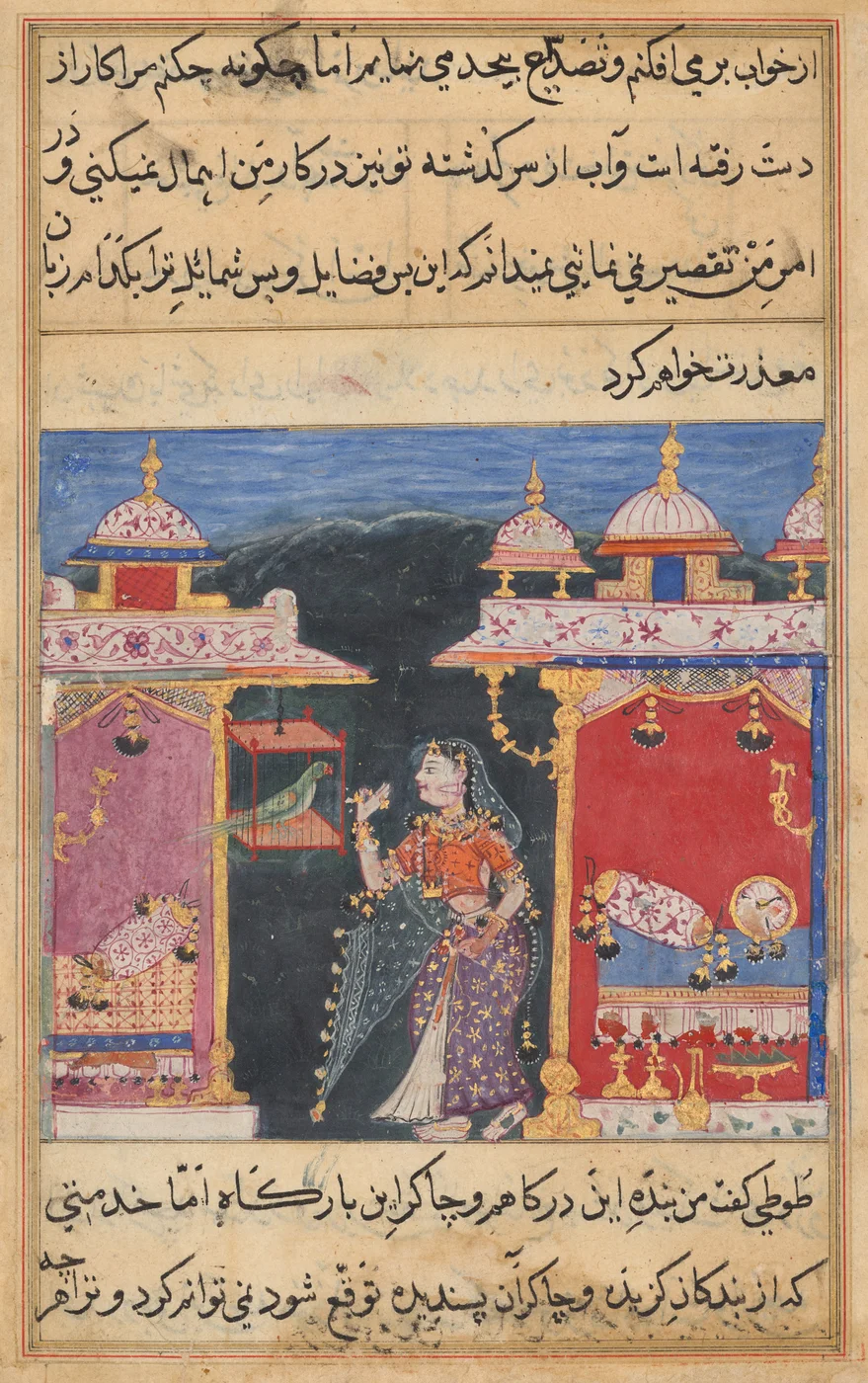
The style changed dramatically in the 16th century. When the Mughal emperor Humayun returned to India, he brought two Persian masters with him, Mir Sayyid Ali and Abd al-Samad. Under his son Akbar, they led a large imperial workshop in which Persian training met Indian painters. Early projects included a Tuti-nama (“Tales of a Parrot”) around 1560 and the vast Hamzanama, which the court historian Badayuni says took from 1567 to 1582 to complete. Mughal painting moved towards naturalistic portraits, court scenes, animals and flowers. Our guide to Mughal miniature painting covers that story in depth.
Rajput courts of Rajasthan and the hills
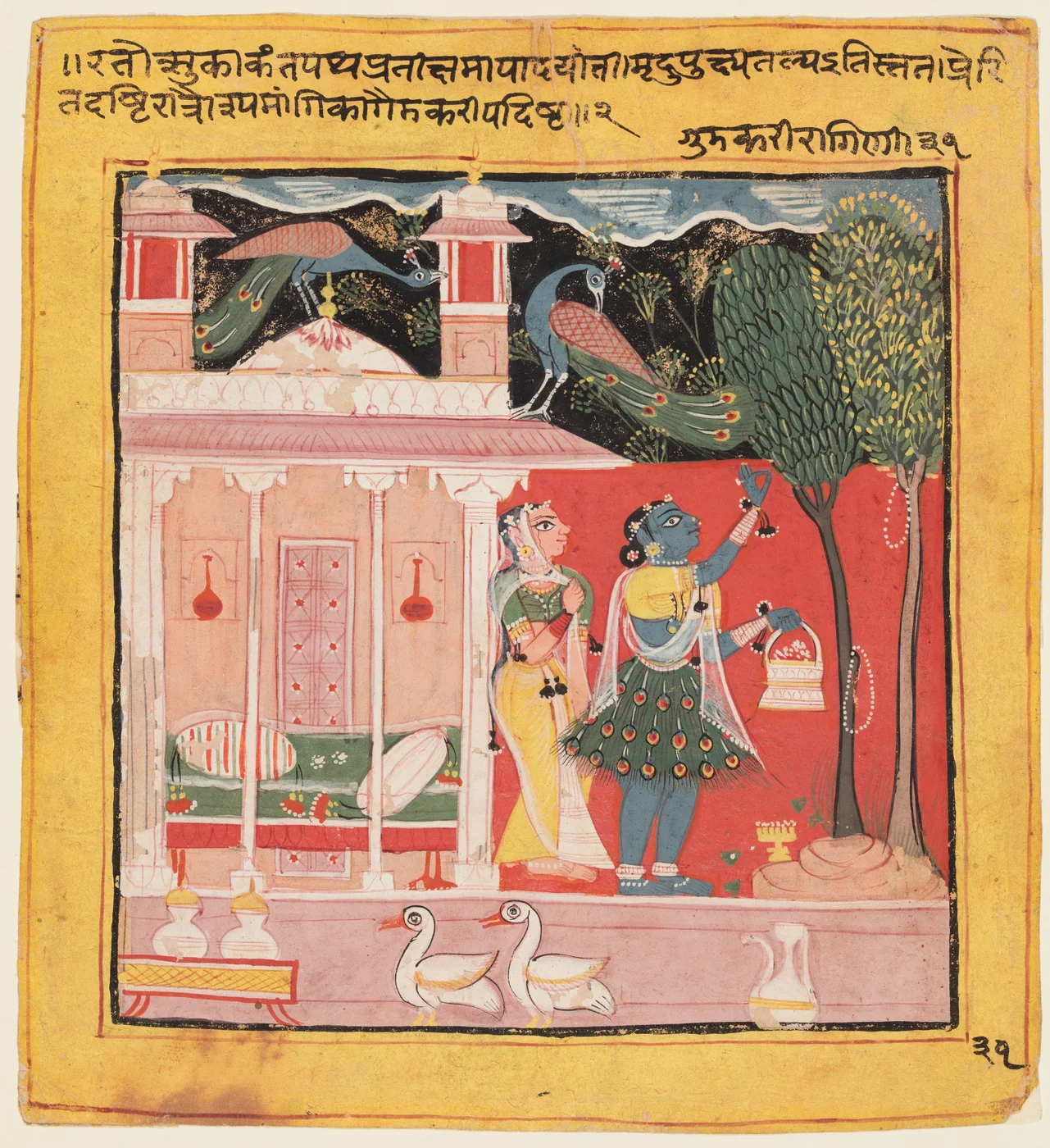
Hindu Rajput rulers had their own painters, and their art took a different path: bolder colour, flatter space and a deep love of poetry, music and Krishna. Art historians, following Ananda Coomaraswamy, group this work as “Rajput painting” and split it into two families. Rajasthani schools such as Mewar, Bundi, Kota, Kishangarh, Marwar and Nathdwara grew up across the plains (a Ragamala set painted in 1605 is among the early landmarks). Pahari (“of the hills”) schools such as Basohli, Guler and Kangra flourished in the small hill states of Jammu and Himachal Pradesh from the late 17th century. See our guides to Rajasthani painting schools and Pahari painting.
The Deccan
Further south, the courts of the Deccan sultanates, Bijapur, Golconda and Ahmadnagar among them, developed their own rich, dreamy style from the late 16th century. Their rulers had direct links with the Persian world, and Golconda painting also absorbed Ottoman influences, which shows in the plain gold backgrounds, tall elegant figures and opulent textiles. After a quieter period, Deccani painting revived in the mid 18th century, by then centred on Hyderabad.

How a miniature is made
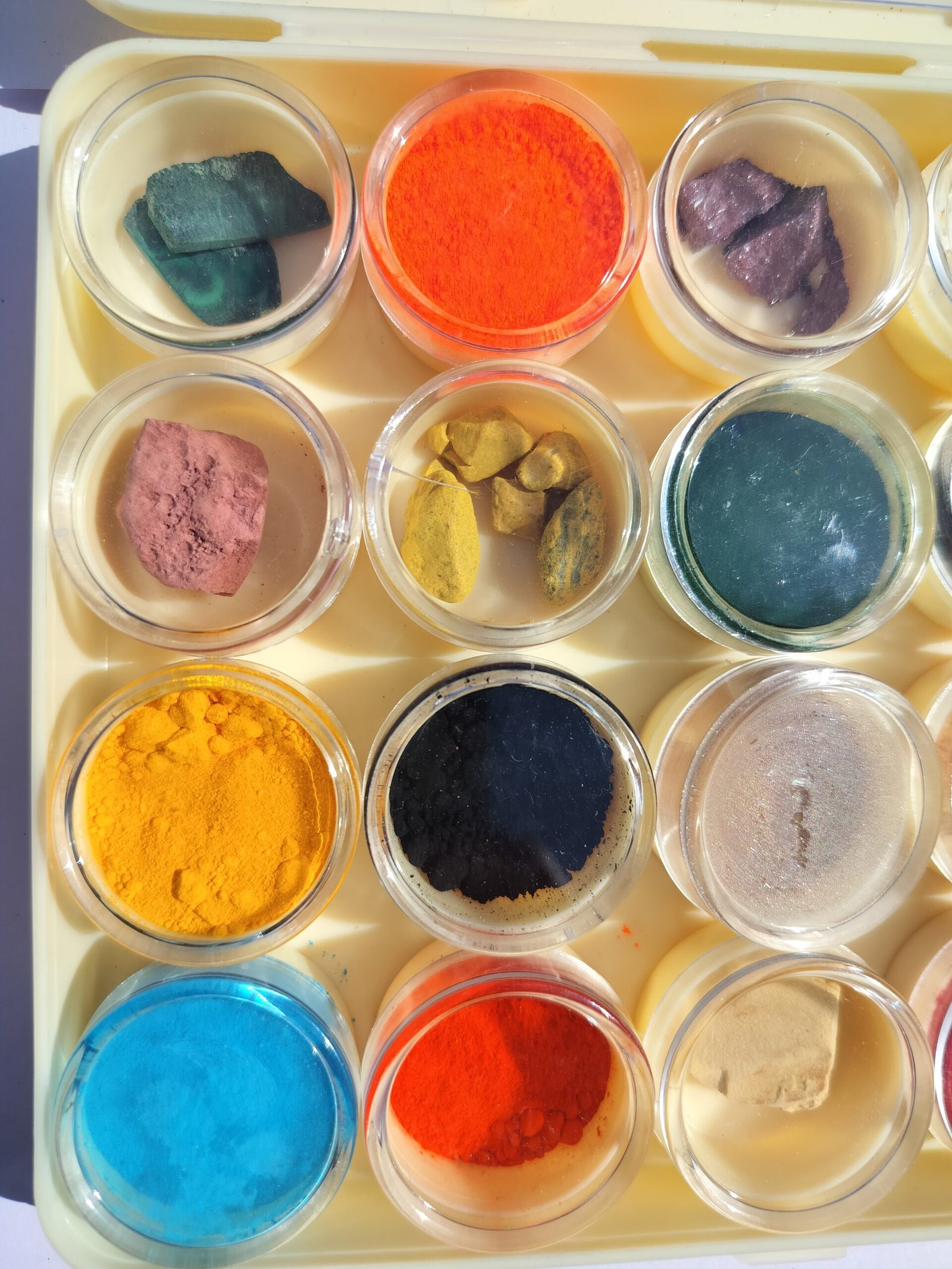
The materials explain much of the look. A traditional miniature is painted on wasli, a handmade paper made by pasting several thin sheets together and burnishing the surface smooth, so it takes very fine lines without bleeding. Colours are ground from minerals and plants (ultramarine from lapis lazuli, greens from malachite, reds from cinnabar and earth) and bound with gum, then applied in thin, opaque layers. Gold and silver are used as leaf or as powdered “shell gold” for jewellery, borders and halos.
The process runs roughly like this:
- Drawing: the composition is sketched, often transferred from an earlier drawing, then corrected in a light red or brown line.
- Priming and colour: a thin white ground is laid down, followed by large areas of background and architecture.
- Burnishing: between layers, the painting is placed face down on a smooth surface and rubbed from the back, traditionally with a polished stone such as agate, which compacts the paint and gives that enamel-like sheen.
- Detail: faces, eyes, jewellery, textiles and hair are added last with very fine brushes.
- Borders: the painting is finished with ruled lines and a decorated border, called a hashiya in the Mughal tradition.
In the imperial Mughal workshop, one page was often shared between specialists, with one artist designing the composition and another painting the colours or the faces. If you would like to try the materials yourself, our natural stone colours pack contains 20 traditional pigments, and our miniature painting classes teach the technique from the first line.
The main schools at a glance
| School | Region | Peak | What to look for |
|---|---|---|---|
| Pala and Jain | Bihar, Bengal; Gujarat | 10th to 15th c. | Small panels in manuscripts, red grounds, angular figures |
| Mughal | Agra, Delhi, Lahore | 16th to 17th c. | Portraits, court life, natural history, soft modelling |
| Rajasthani | Mewar, Bundi, Kota, Kishangarh, Marwar | 17th to 19th c. | Strong colour, Krishna themes, Ragamala, royal hunts |
| Pahari | Basohli, Guler, Kangra, Chamba | late 17th to 19th c. | From fiery Basohli to lyrical Kangra romance |
| Deccani | Bijapur, Golconda, Hyderabad | late 16th to 18th c. | Rich gold, Persianate figures, dreamy landscapes |
Hand-painted or printed? How to check
Printed “miniatures” on canvas and paper are everywhere, and some are sold as hand-painted. A few checks help:
- Use a magnifying glass or your phone camera zoom. Prints break into a regular dot pattern. Paint shows brush marks, tiny overlaps and slight texture.
- Look at the gold. Real gold or gold paint catches the light differently as you tilt the painting; printed gold stays flat and brownish.
- Check repeated details. Flowers in a border or pearls in a necklace are never identical when painted by hand.
- Feel the surface (gently, at the edge). Burnished paint feels smooth but slightly raised compared with the paper.
- Ask direct questions. A genuine seller can tell you the surface, the colours used and roughly how long the work took.
Buying a miniature for your home
Original contemporary miniatures are painted by hand from start to finish, so prices reflect size and the hours involved rather than a print run. Across our Indian miniature paintings collection, almost every work is painted on handmade paper in watercolour and stone colours. Most are priced between about ₹8,000 and ₹90,000, with a few larger or exceptionally detailed works above that.

Some practical points before you choose:
- Pick the school first, then the subject. If you love intense colour, look at Basohli paintings; for softer romance, Kangra paintings; for portraits and court scenes, Mughal paintings.
- Hang it where people can get close. A miniature loses its magic across a big room. A study, a reading corner, a staircase wall or a group of three or four small works above a console all work well.
- Frame with a wide mount. A generous mount gives a small painting presence on the wall, and glass protects the surface from dust and touch.
- Keep it out of direct sun and damp, which fade natural pigments and cockle the paper.
A few works from our collection show the range well: the Mughal Court miniature with its crowded darbar, the Art of Bundi painting, a Hyderabad school Deccan painting and Radha Krishna in a bower in the Pahari manner.
Frequently asked questions
The word comes from the Latin miniare, “to colour with minium” (red lead), used for manuscript decoration. Because those pictures were small, “miniature” came to mean a small, detailed painting meant for close viewing.
There is no single state. Rajasthan is the best-known centre today, but major schools also grew up in Himachal Pradesh and Jammu (Pahari painting), in Mughal Delhi and Agra, and in the Deccan.
The main families are Pala and Jain manuscript painting, Mughal painting, Rajasthani painting, Pahari painting and Deccani painting, each with several regional schools.
Traditionally, handmade wasli paper, mineral and plant colours bound with gum, gold and silver, and very fine brushes. The surface is burnished to give it a smooth sheen.
The oldest surviving examples are illustrations in Buddhist palm-leaf manuscripts from the Pala period in eastern India, with dated examples from the late 10th century.
Yes. Artists in Rajasthan, Himachal Pradesh and elsewhere still paint miniatures by hand using traditional methods, both copies of classic works and new compositions.
