
Indian Art
Basohli Painting: History, Features and How to Recognise the Style

Oct
In short: Basohli painting is the earliest distinct school of Pahari (hill) painting, named after the small hill state of Basohli in today’s Kathua district of Jammu and Kashmir. It flourished from the late 17th to the mid 18th century and is known for blazing flat backgrounds, strong outlines, large expressive eyes and, in the finest works, real beetle-wing fragments used as emeralds.
Put a Basohli painting next to almost any other Indian miniature and it is the one you notice first. The colours are hot, the figures sit against a single plane of mustard yellow or deep red, and the eyes seem too big for the faces. It is intense, theatrical and very deliberate. Here is where it came from, what to look for, and how it differs from the gentler Kangra style that followed.
Where is Basohli?
Basohli is a small town on the right bank of the river Ravi in Kathua district, in the Jammu region. The town was rebuilt as the capital of a little Rajput hill state in the 17th century, and its palaces, now mostly in ruins, once looked across the river towards Himachal Pradesh. The kingdom was tiny, but it sat among a cluster of hill courts, including Nurpur, Mankot, Jammu, Chamba and Guler, whose painters moved between patrons and shared ideas. That network is why Basohli matters: it is where the hill style first became recognisably its own.
How the style began
The finest early works are two famous sets, an illustrated Rasamanjari and the so-called Tantric Devi series, both dated by scholars to around 1660 to 1670. The Rasamanjari (“blossom-cluster of delight”) is a Sanskrit poem by Bhanudatta that classifies heroes, heroines and their moods in love. Basohli painters cast Krishna and Radha as the lovers, and the Victoria and Albert Museum describes its pages from this set as “one of the earliest painted in a distinctly Pahari manner”.
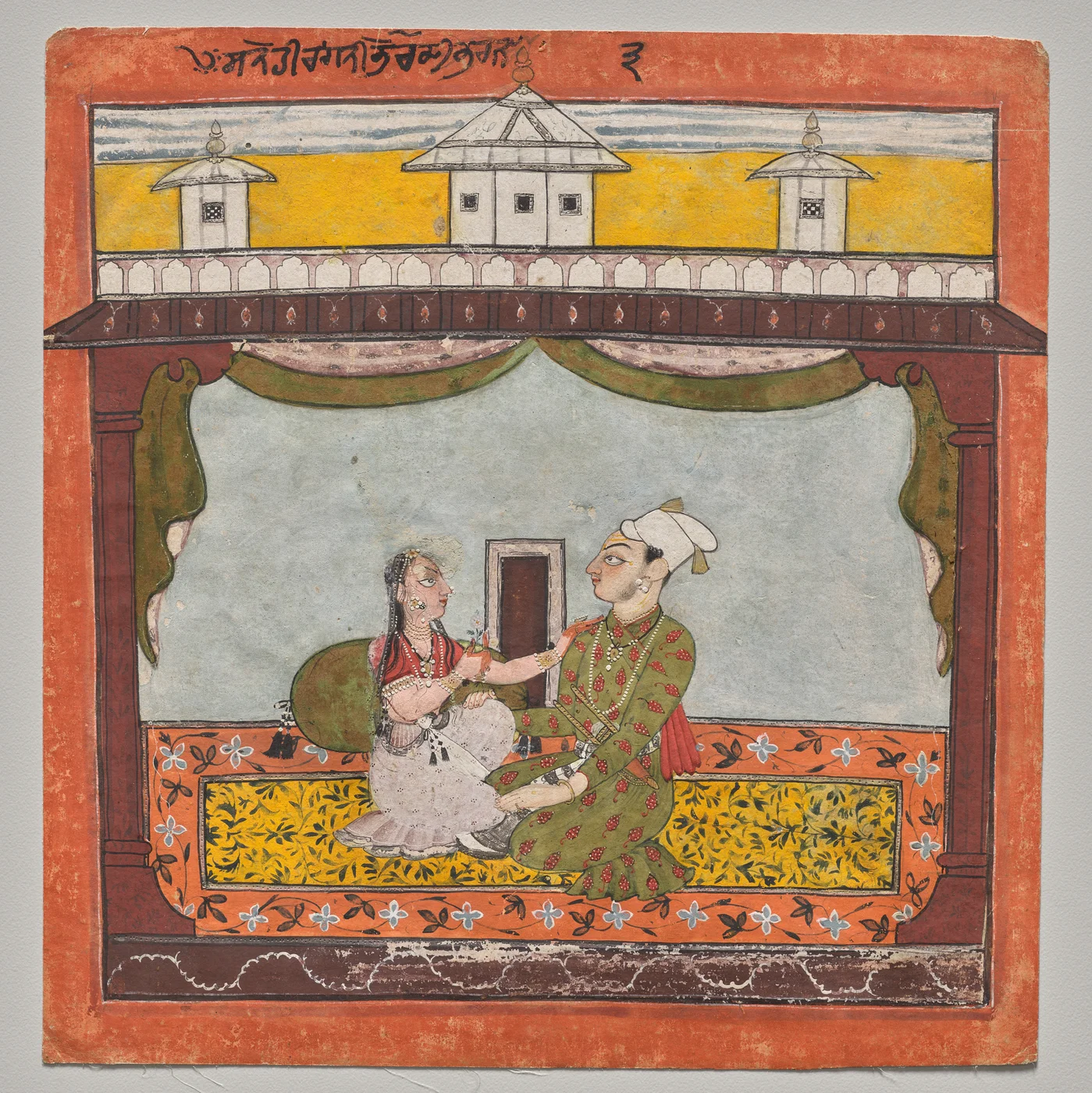
Who painted them is a good example of how art history keeps refining itself. The art historians B. N. Goswamy and Eberhard Fischer attribute these early masterpieces to a painter named Kripal of Nurpur. His son Devidasa painted his own Rasamanjari for Raja Kripal Pal of Basohli, who reigned in the late 17th century (usually given as 1678 to 1695, though some sources end his reign a little earlier). The name “Basohli style” itself was only coined in 1929, by the scholar Ajit Ghose, and research since then suggests that the leading family of painters lived in Nurpur rather than in Basohli town. So “Basohli” is best read as the name of a style that centred on that court, not a promise that every painting was made there.
What to look for in a Basohli painting

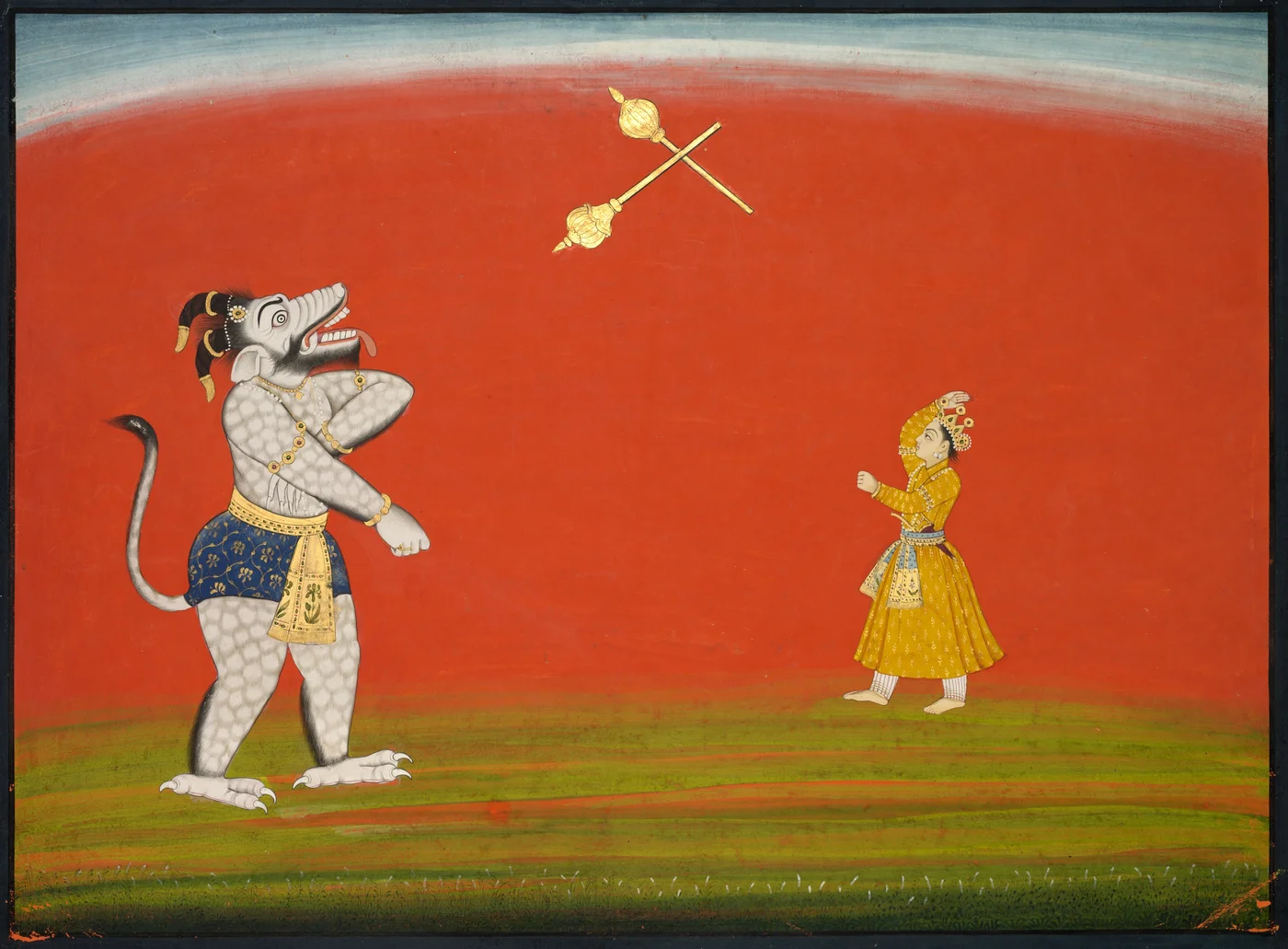
- A single flat background colour. Mustard yellow, brick red, chocolate brown or deep green fills the space behind the figures, with no attempt at a receding landscape.
- Strong, confident outlines and figures that are slightly angular, almost stage-like.
- Large lotus-shaped eyes set in profile faces, with a sloping forehead running straight into the nose. The eye is the emotional centre of the picture.
- Architecture as a frame. Small pavilions, domes and wall niches, sometimes with apples or vessels in the alcoves, divide the picture into compartments.
- Beetle-wing jewellery. In the best early sets, tiny pieces of iridescent green beetle wing-case were glued on to stand for emeralds, so the jewellery still glints when the page is tilted. The V&A records this on both its Rasamanjari and Gita Govinda pages.
- A red border around the picture and, often, a short inscription at the top in Takri, the script of the Punjab Hills, naming the scene or the heroine.
The feeling of these paintings is as distinctive as the look. They are less interested in telling a story step by step than in capturing a single heightened emotion: longing, jealousy, pride or delight.
Famous Basohli series
Beyond the early Rasamanjari and Tantric Devi sets, two later projects show how the style developed.
A closer look: Markandeya and the cosmic ocean
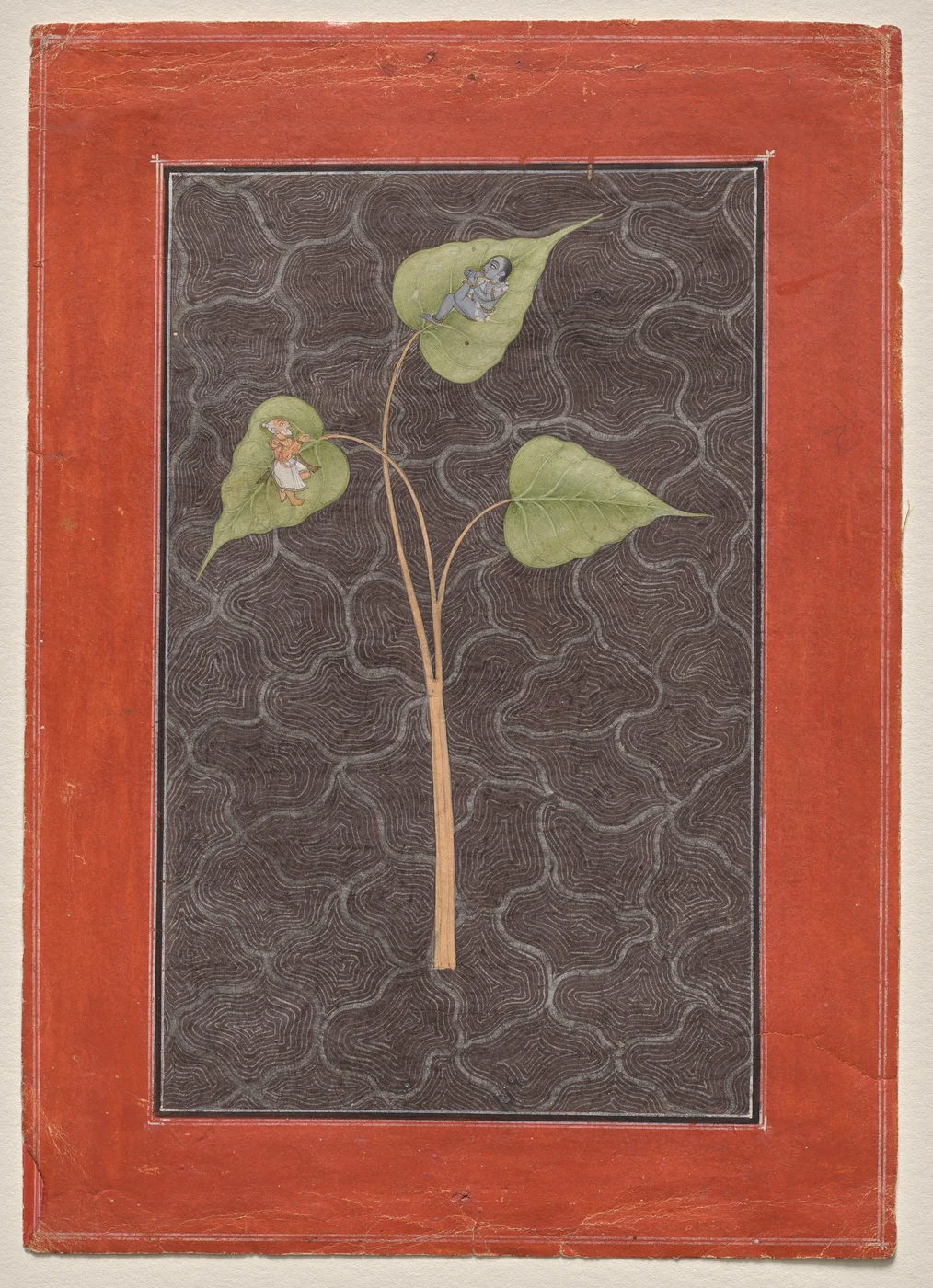
A small painting from around 1680, now in the Cleveland Museum of Art, shows how far Basohli artists were willing to push abstraction. It illustrates the sage Markandeya, who was granted immortality and so survives even the dissolution of the world. Instead of painting waves, the unnamed court artist turned the cosmic ocean into a web of concentric patterns, with the child Krishna floating calmly within it. There is no horizon and no depth, just pattern, colour and a few figures. It is a good reminder that the flatness of Basohli painting was a choice, not a lack of skill.
The Gita Govinda of 1730
This set illustrates Jayadeva’s 12th-century poem about the love of Radha and Krishna. According to the V&A, it was commissioned in 1730 for a lady patron, probably named Malini, and painted by Manaku, from the Guler family of artists and elder brother of the celebrated Nainsukh. Here the Basohli colour remains, but trees, hills and spring blossoms start to fill the space, a hint of what was coming.
The “Large Basohli” Bhagavata Purana
Painted around 1760 to 1765, these big pages from the Bhagavata Purana still use bold contrasting backgrounds, but the drawing is calmer and the compositions more open. Several pages are now in the Cleveland Museum of Art. By this time the softer naturalism of Guler and Kangra was spreading across the hills, and Basohli’s own fiery idiom was fading.
Basohli vs Kangra: how to tell them apart
| Basohli | Kangra | |
|---|---|---|
| Period | Late 17th to mid 18th century | Mid 18th to 19th century, peak under Raja Sansar Chand |
| Colour | Hot primaries, flat single-colour grounds | Cool, soft greens, pinks and blues |
| Space | Flat, compartment-like | Deep landscapes, rivers and distant hills |
| Faces | Large eyes, sloping forehead, intense expression | Delicate, graceful, idealised features |
| Mood | Dramatic and emotional | Lyrical and romantic |
For the wider picture of how these hill schools relate, see our guide to Pahari painting, and for where Basohli sits among India’s other traditions, our guide to Indian miniature painting.
Basohli painting today
The style is very much alive. Basohli painting has received a Geographical Indication (GI) tag, which recognises it as a craft tied to its home region, and the Kathua district administration has chosen Basohli paintings as one of the district’s products under the One District One Product (ODOP) scheme. Contemporary artists paint Basohli-style works by hand, following the classic palette and compositions or adapting them to new subjects.
Bringing a Basohli painting home
Because the colour is so strong, a Basohli painting holds its own on a plain, light wall and can anchor a room by itself. A few tips:
- Give it space. One Basohli piece on an otherwise quiet wall looks better than a crowded gallery wall.
- Pick a mount that calms the colour. An ivory or off-white mount with a thin dark frame lets the yellow and red glow without competing.
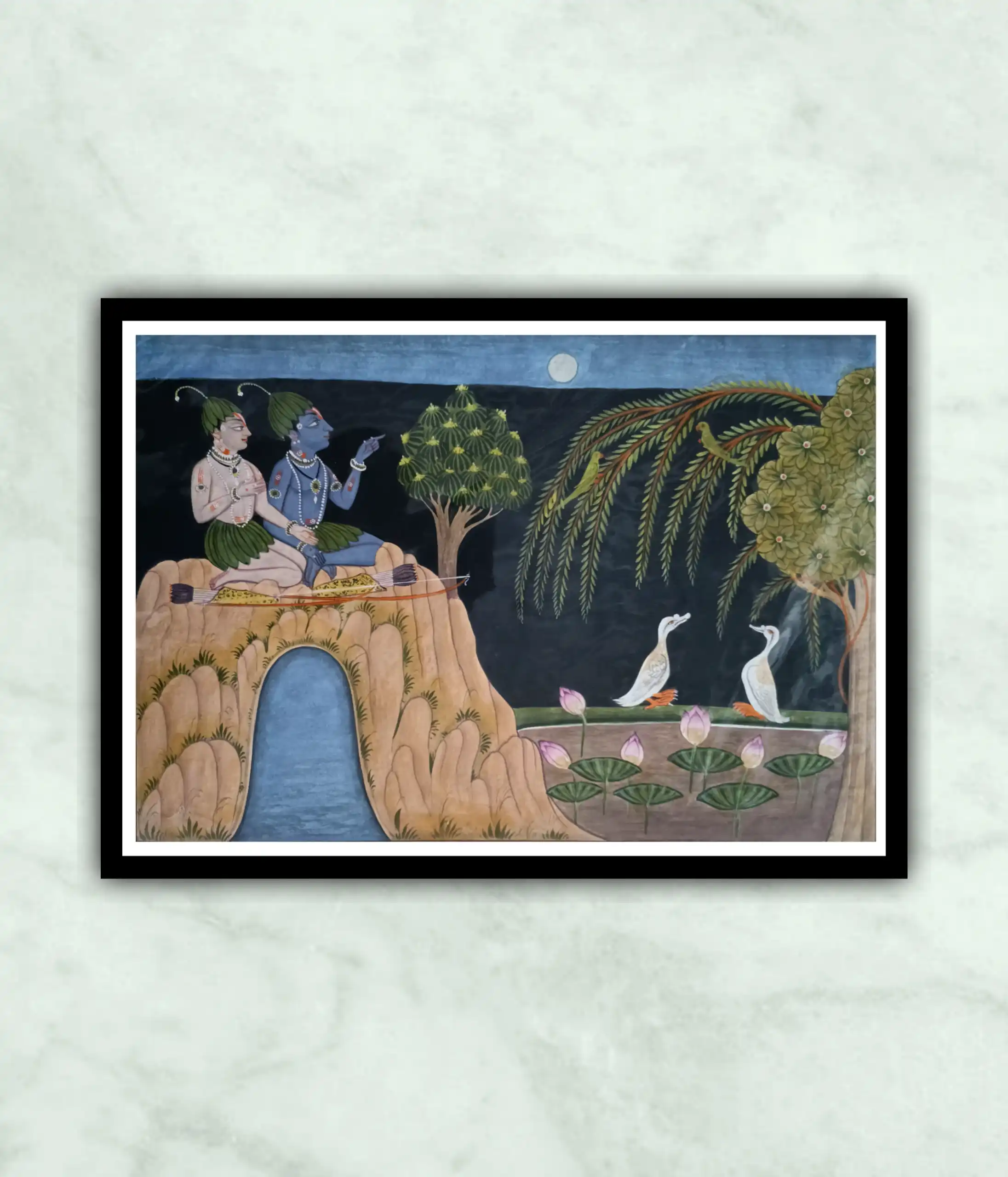
- Match the subject to the room. Radha and Krishna suit a bedroom or living room; scenes of Rama or Krishna with friends work well in a family space or study.
Our artists paint contemporary hand-painted works in the Basohli manner. You might start with Krishna with his friends, the Ram Laxman painting or Radha Krishna in a bower, and for smaller budgets the Radha Krishna love theme painting. Browse the full Basohli paintings collection, or explore more Radha Krishna paintings across styles.
Frequently asked questions
Basohli painting comes from Basohli, a town on the river Ravi in Kathua district of the Jammu region, Jammu and Kashmir. It is part of the Pahari (hill) tradition of painting.
Scholars attribute the earliest masterpieces, painted around 1660 to 1670, to Kripal of Nurpur. His son Devidasa worked for Raja Kripal Pal of Basohli in the late 17th century.
Flat single-colour backgrounds, bold primary colours, strong outlines, large expressive eyes in profile faces, red borders, Takri inscriptions and, in the finest works, beetle-wing fragments used as jewels.
Basohli is earlier, bolder and flatter, with hot colours and intense emotion. Kangra, which followed in the mid 18th century, uses cooler colours, deep landscapes and delicate, lyrical figures.
Favourite texts include the Rasamanjari of Bhanudatta, Jayadeva’s Gita Govinda, the Bhagavata Purana and the Ramayana, along with Ragamala and devotional subjects.
Yes. Basohli painting has been granted a Geographical Indication tag, recognising it as a traditional craft of the Basohli region.
