
 Indian Miniature
 Painting Styles
 Modern Art
 Portraits & Gifts
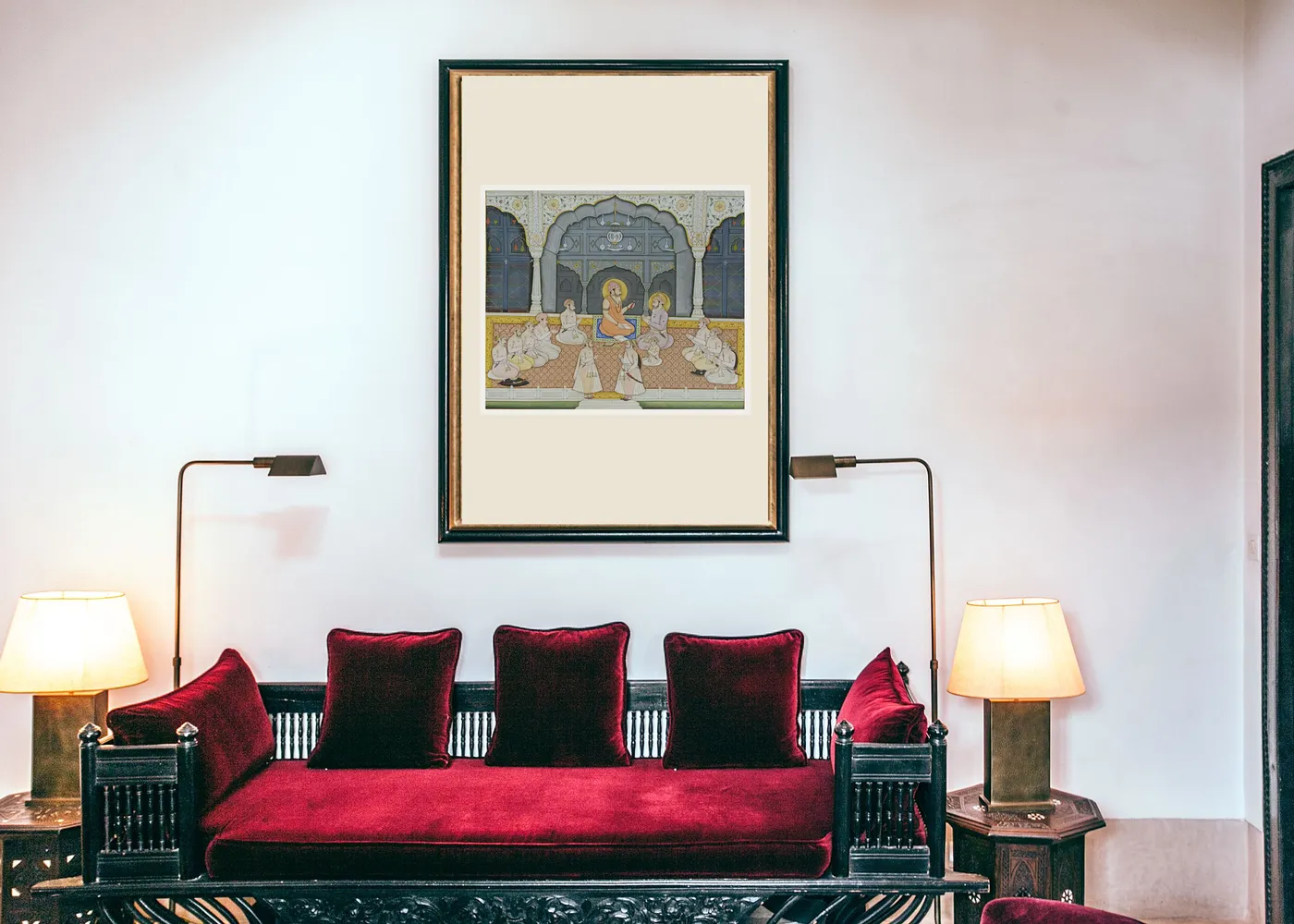


In short: Mewar painting is the miniature painting tradition of the Mewar kingdom of Rajasthan, centred on Chawand and later Udaipur. It is one of the oldest and most traditional Rajput schools, known for flat, bright primary colours, bold outlines and lively storytelling. Its great early master was Sahibdin, who painted the famous Ramayana and Ragamala sets of the 17th century. Later Mewar artists turned to large, crowded scenes of the Maharana’s court, hunts and festivals.
Mewar painting is easy to love and surprisingly easy to recognise once you know what to look for. The reds are redder, the yellows brighter, the outlines bolder than almost anywhere else in Rajasthan. Stories unfold across a single page, palaces sit beside forests, and gods, kings and heroines all share the same vivid world. It is the art of a court that prided itself on tradition, and that pride shows in every brushstroke.
Mewar: the most traditional Rajput court
Mewar, ruled by the Sisodia dynasty, was the last of the great Rajput kingdoms to accept Mughal authority, holding out until 1615. Its long resistance, rooted in orthodox Hindu tradition, became legendary, and the same conservatism shaped its art. Historians describe Mewar painting as a reflection of the unchanging social and cultural values of the most traditionalist of the Rajput courts. Where other states absorbed Mughal refinement, Mewar kept faith with an older Indian way of painting: flat colour, strong line and a love of narrative.
The beginnings: the Chawand Ragamala of 1605
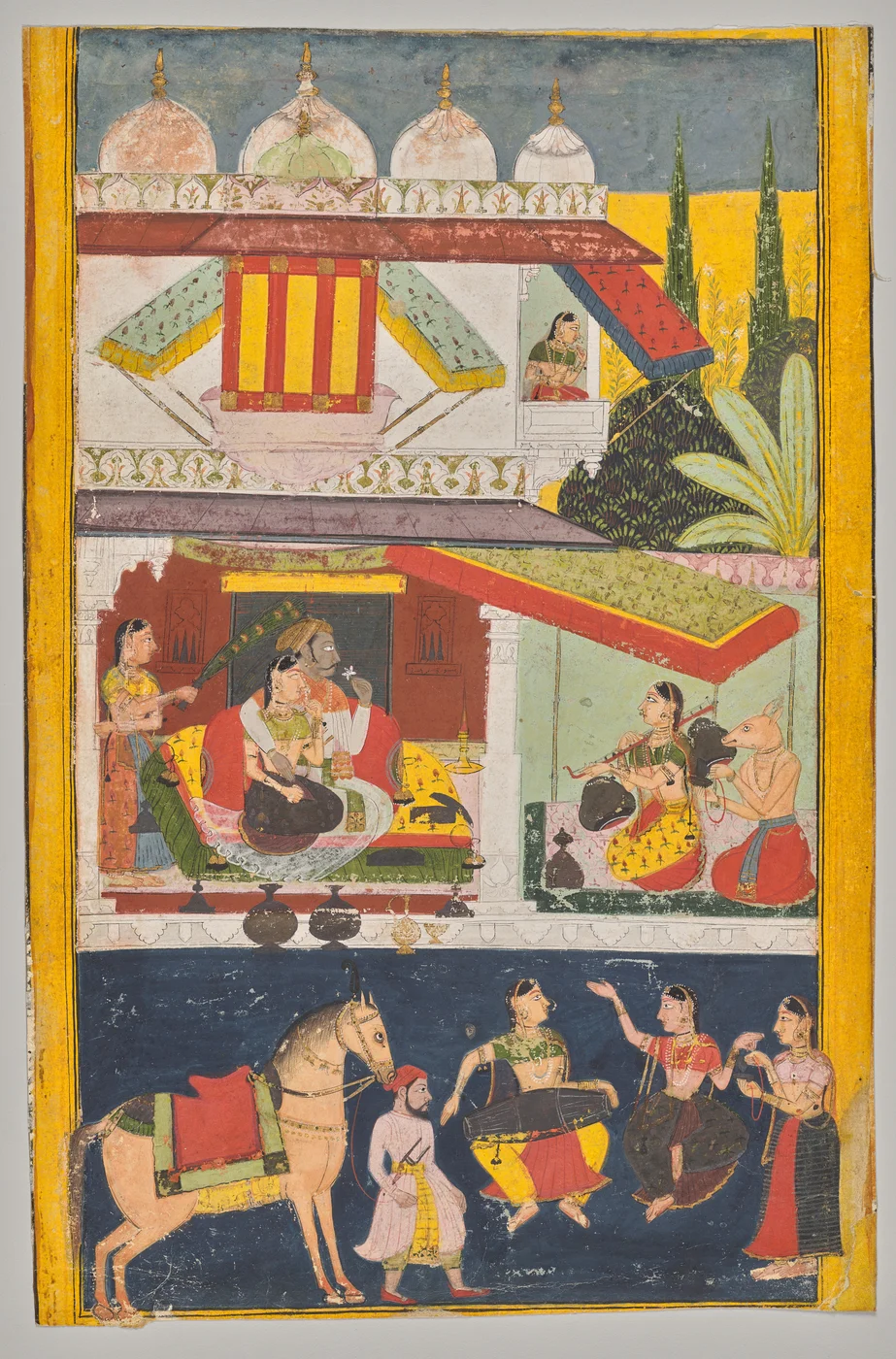
The first securely dated Mewar painting, and one of the earliest dated Rajput works of any school, is the Chawand Ragamala of 1605. It was painted at Chawand, Mewar’s capital at the time, by an artist named Nasiruddin. A Ragamala is a set of paintings that gives visual form to the musical modes (ragas and raginis), each with its own mood, season and time of day. Nasiruddin’s work is close in style to 16th-century manuscripts known as the Chaurapanchashika group, which carry a pre-Mughal idiom of flatness, bold line and bright colour.
Sahibdin and the golden age
The greatest name in early Mewar painting is Sahibdin, who worked for Maharana Jagat Singh I (ruled 1628 to 1652). He was a Muslim painter producing Hindu devotional works of great beauty for Hindu patrons, and he is one of the few Rajput artists whose name we still know. His surviving works include:
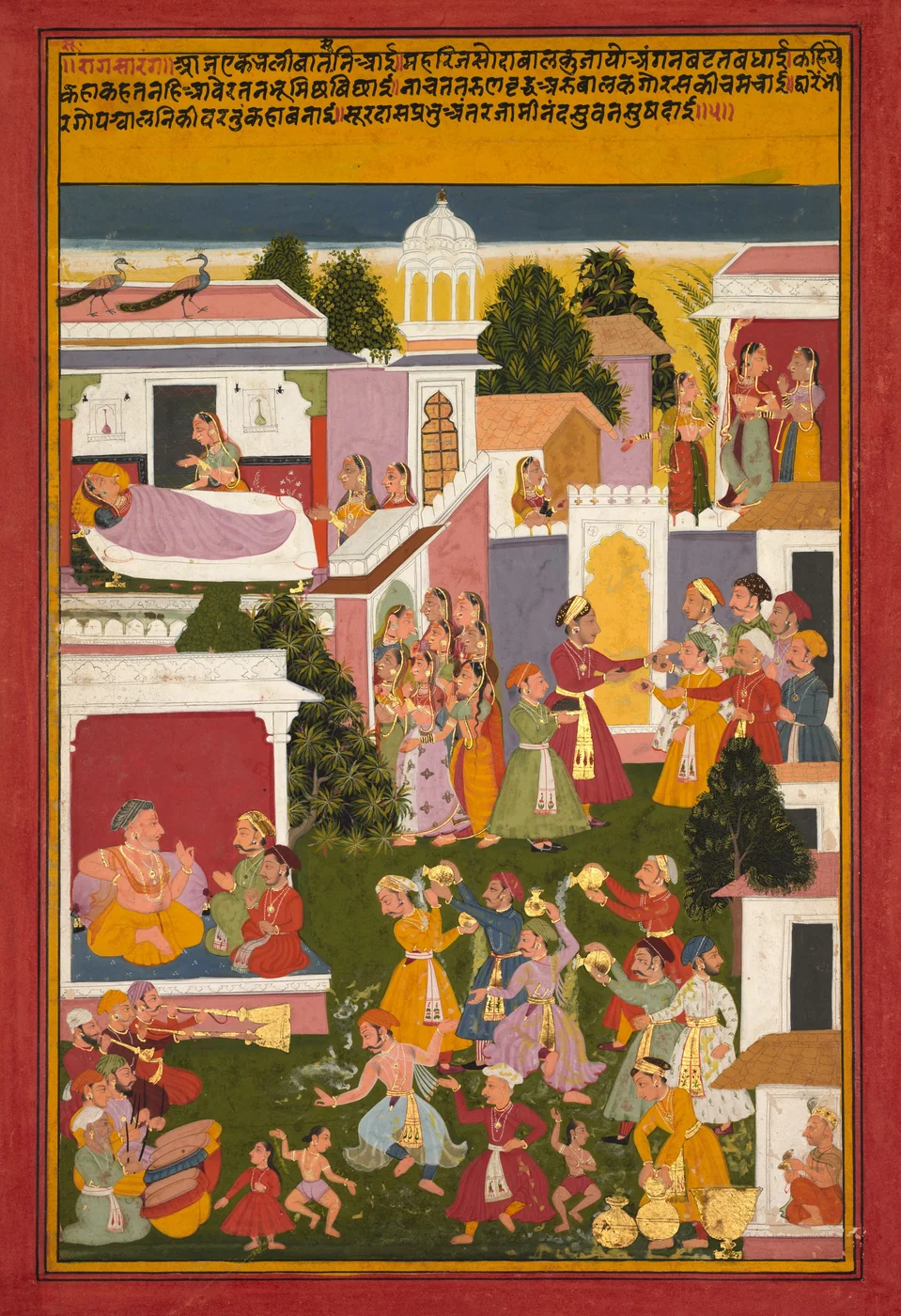
- A Ragamala of 1628, with vibrant primary colours and a touch of popular Mughal style.
- A Bhagavata Purana of 1648, telling the stories of Krishna.
- The monumental Ramayana, Jagat Singh’s largest project, with volumes dated between 1649 and 1653, including Sahibdin’s illustrations to the Yuddha Kanda (the book of war) of 1652.
Jagat Singh’s reign produced an enormous output of painting, including a genealogy of the Sisodia Rajputs in 1645. Another painter, Manohar, worked on the Ramayana with Sahibdin in a harsher, less flexible manner. For a long time afterwards, Mewar manuscript painting rarely went beyond imitating or elaborating on Sahibdin’s achievement.
How to recognise a Mewar painting
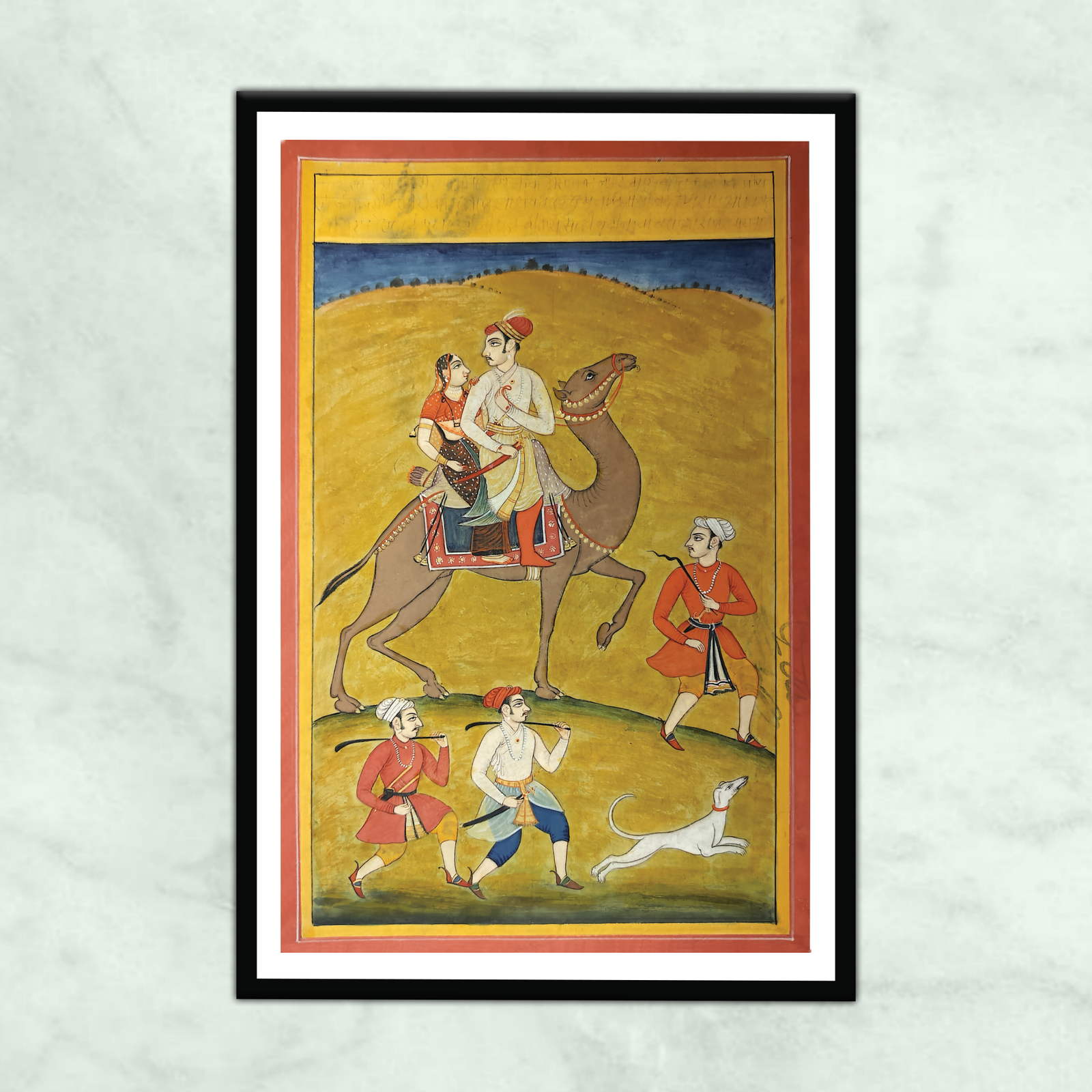
- Flat, bright primary colours: red, yellow, blue and green, often in large unbroken areas, with very little shading.
- Bold outlines: figures are drawn with strong, confident contours.
- Several moments in one picture: the same figure can appear more than once as a story unfolds across the page.
- Little perspective: palaces, trees and rivers are arranged for clarity rather than realism, sometimes from several viewpoints at once.
- Distinctive faces: large almond-shaped eyes and strong profiles.
- Musical and devotional themes: Ragamala, the Bhagavata Purana, the Ramayana, and Krishna’s life.
Our Maru Ragini in the Mewar school shows this style well: a Ragamala subject in warm, flat colour with a clear, graphic composition.
Udaipur and the art of court reportage
Around 1700 Mewar painting changed direction. An anonymous artist known today as the Stipple Master (active about 1692 to 1715) used a fine, drawing-like technique with delicate shading and often left the paper partly uncoloured. He produced intimate portraits of Maharana Amar Singh II (ruled 1698 to 1710) and large court scenes, and this new court reportage shaped the later Udaipur school.
Under Sangram Singh II (ruled 1710 to 1734), scenes of darbars, festivals, hunts, temple visits and animal fights became ever larger and more crowded, giving a full record of the ruler’s public life. Jagat Singh II (ruled 1734 to 1751) and his successors continued these big pictures. The painter Jai Ram (active about 1720 to 1751) seems to have been behind a series of upright paintings of Rasalila dance dramas performed before Jagat Singh II, and later the young Bagta brought new order to crowded compositions.
A closer look: Prince Amar Singh drives his own elephant
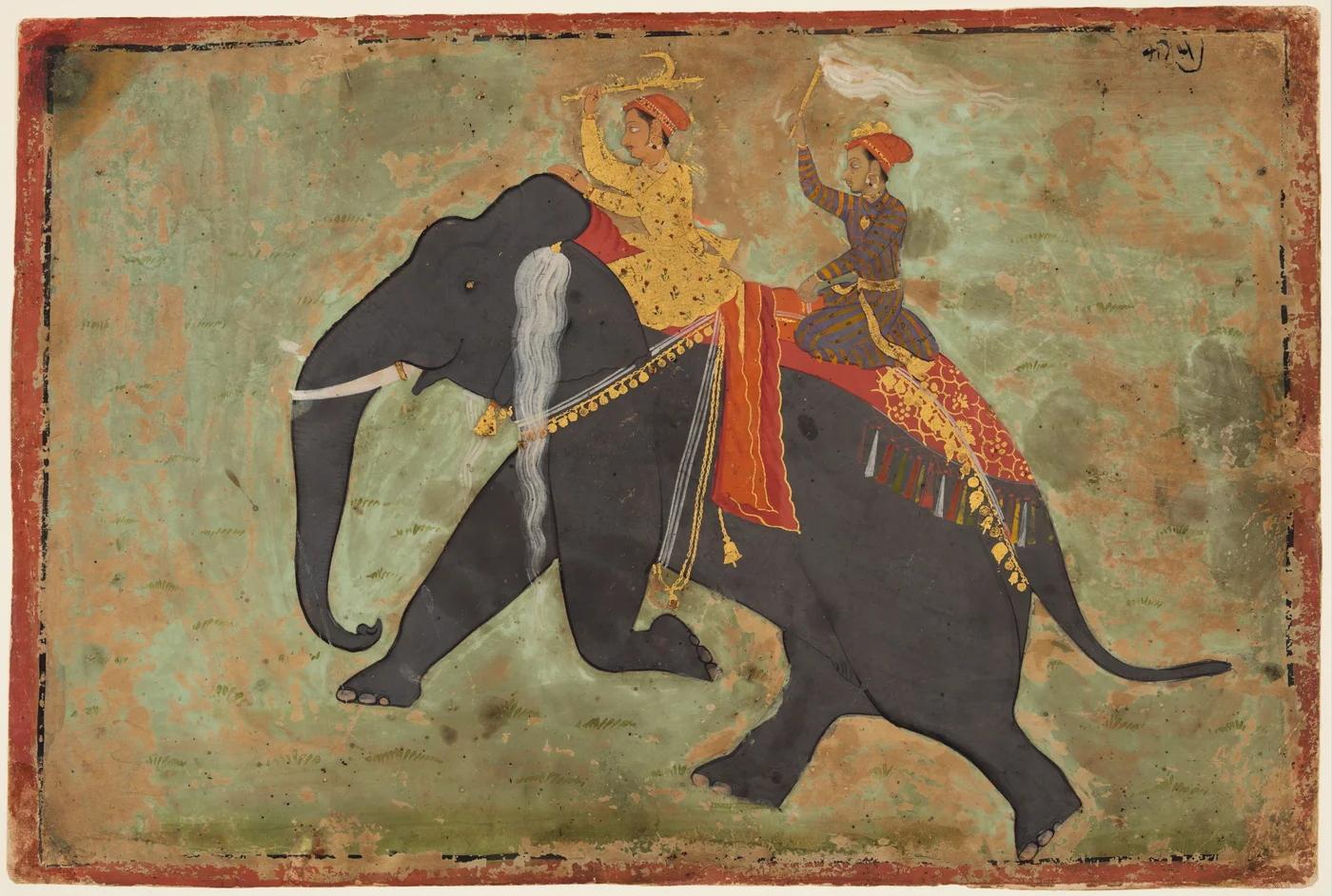
A painting of about 1695 in the Cleveland Museum of Art shows Prince Amar Singh, the future Maharana Amar Singh II, riding and steering his own elephant. It comes from exactly the moment when Mewar artists began recording real events at court. The elephant fills the page, the prince sits confidently on its neck, and the attendants are reduced to small figures around it: a clear statement of royal power and personal courage.
A closer look: Jagat Singh II at the Raslila
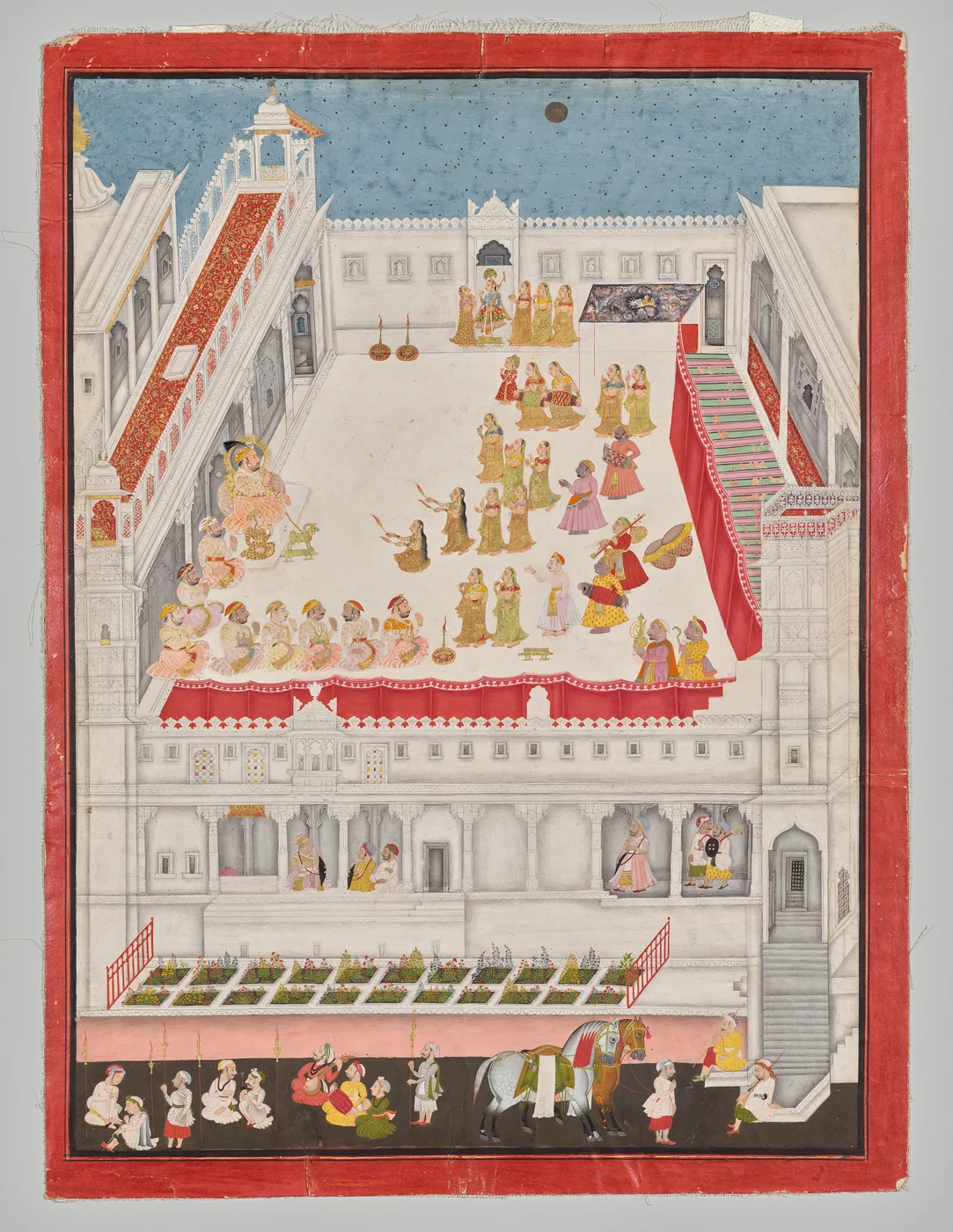
Another Cleveland painting, dated 1736, shows Maharana Jagat Singh II watching a performance of the Raslila, the dance drama of Krishna and the gopis. The ruler and his courtiers sit in a pavilion while dancers circle below, so devotion and court life share one picture. Paintings like this are part of the series of Rasalila scenes painted for Jagat Singh II, and they show how Mewar artists combined faith, music and spectacle.
Portraits of rulers and nobles remained popular too. Our Portrait of Thakur Biramdevji in Mewar shaili belongs to this tradition of formal Rajput portraiture.
Deogarh, Nathdwara and Mewar’s wider family
After the mid 18th century, painting at Udaipur declined for a time, and some artists moved to the courts of Mewar’s nobles. The most famous was Bagta (active 1756 to 1811), who spent the rest of his career at Deogarh. There he, his son Chokha (active 1799 to 1824) and Chokha’s son Baijnath kept a vigorous variant of the Udaipur style alive for three generations.
Mewar is also home to Nathdwara, the temple town of Shrinathji, a form of Krishna. Its painters developed the large cloth hangings known as Pichwai, which carry Mewar’s love of bright colour into devotional art. Read more in our guide to Pichwai painting or browse our Nathdwara paintings.
Mewar compared with other Rajasthani schools
| Mewar | Bundi and Kota | Kishangarh | |
|---|---|---|---|
| Roots | Pre-Mughal Indian idiom | Mughal-trained workshops | Mughal refinement |
| Colour | Flat, bright primaries | Warm and rich (Bundi), sparse (Kota) | Soft, delicate |
| Famous for | Ramayana, Ragamala, court scenes | Lovers and gardens, royal hunts | Radha and Krishna, Bani Thani |
| Key names | Nasiruddin, Sahibdin, Stipple Master, Bagta | Hada Master, Shaykh Taju | Nihal Chand |
See our guides to Bundi and Kota painting, Bani Thani and the Kishangarh style and all the Rajasthani schools.
Bringing a Mewar painting home
Because of their strong colours and clear shapes, Mewar paintings read well from across a room, so they work beautifully in living rooms, entrances and dining areas. Ragamala subjects suit music rooms and bedrooms, while devotional scenes of Krishna or Rama belong in a calm spot at eye level, such as a pooja corner. Frame works on paper behind glass with a cream or red mount, and keep them away from direct sun and damp walls.

All our Mewar and Rajasthani paintings are hand-painted in Jaipur with stone colours on handmade paper. If you would like a particular Ragamala or Ramayana scene, ask us about a custom painting.
Frequently asked questions
Mewar painting is the miniature painting tradition of the Mewar kingdom of Rajasthan, centred on Chawand and Udaipur, known for flat bright colours, bold outlines and narrative scenes from the Ramayana, Ragamala and court life.
Sahibdin, who worked for Maharana Jagat Singh I in the 17th century and painted a Ragamala of 1628, a Bhagavata Purana of 1648 and the great Mewar Ramayana of 1649 to 1653.
The Chawand Ragamala of 1605, painted by Nasiruddin, is the first securely dated Mewar painting and one of the earliest dated Rajput works.
Flat primary colours, strong outlines, little shading or perspective, several moments of a story in one picture, and devotional and musical themes.
Nathdwara is in the Mewar region, and its Pichwai paintings of Shrinathji grew from the same love of bright colour, though they developed into a distinct devotional tradition.
Yes. Every painting is an original, hand-painted by Artshaili artists in Jaipur with stone colours, never printed.
 Maru Ragini Mewar School Miniature Painting– Hand… Original price was: ₹39,999.00.₹27,999.00Current price is: ₹27,999.00.
 Dancing Radha Krishna Painting in Rajasthani Shaili Original price was: ₹31,999.00.₹29,999.00Current price is: ₹29,999.00.
 Raja Bhoj Painting in Rajasthani Shaili Original price was: ₹21,999.00.₹19,999.00Current price is: ₹19,999.00.
 The Art Of Bundi Miniature Painting Original price was: ₹11,999.00.₹10,999.00Current price is: ₹10,999.00.

Shikha Arya is the author of Artshaili.com blogs and a Student of environmental science at the University of Rajasthan. Except writing, she loves sketching, singing, dancing, and reading.