
Indian Art
Radha Krishna Painting for Home: Meaning, Scenes, Styles and Where to Hang It

Oct
In short: A Radha Krishna painting celebrates devoted love, which is why it is one of the most popular paintings for Indian homes. Couples often choose a calm scene of the two together for the bedroom, while joyful scenes such as the Raas Leela, the swing or Holi suit living rooms and entrances. Pick the scene first, then the painting style, and hang it at eye level on a clean wall where it can be seen and cared for.
Search for a Radha Krishna painting and you will see thousands of options, from printed canvases to tiny hand-painted miniatures. They are not interchangeable. The scene, the painting style and the room all change what the painting says on your wall. This guide walks through each of those choices, so you end up with a piece that feels right rather than one that simply fills a space.
What a Radha Krishna painting means
Radha and Krishna are the most painted couple in Indian art. Krishna grew up among the cowherds of Braj, around Vrindavan and Mathura, and Radha is the gopi he loved above all. Their story is less about marriage than about longing and devotion: in Vaishnava thought, Radha’s love for Krishna stands for the soul’s love for the divine.

Radha’s first major literary appearance is in the Gita Govinda, written by the poet Jayadeva in the 12th century. That poem, with its scenes of meeting, quarrel, separation and reunion in the groves of Vrindavan, gave painters a vocabulary they used for centuries. When you look at a Radha Krishna painting, you are usually looking at one moment from that emotional journey.
Popular scenes and what they suit
The scene matters more than most buyers expect. A few of the most loved ones:
Krishna playing the flute
Krishna’s flute (bansuri) is said to draw Radha, the gopis and even the cows towards him. Flute scenes are calm and lyrical, which makes them a safe choice for almost any room, including a study or a reading corner.
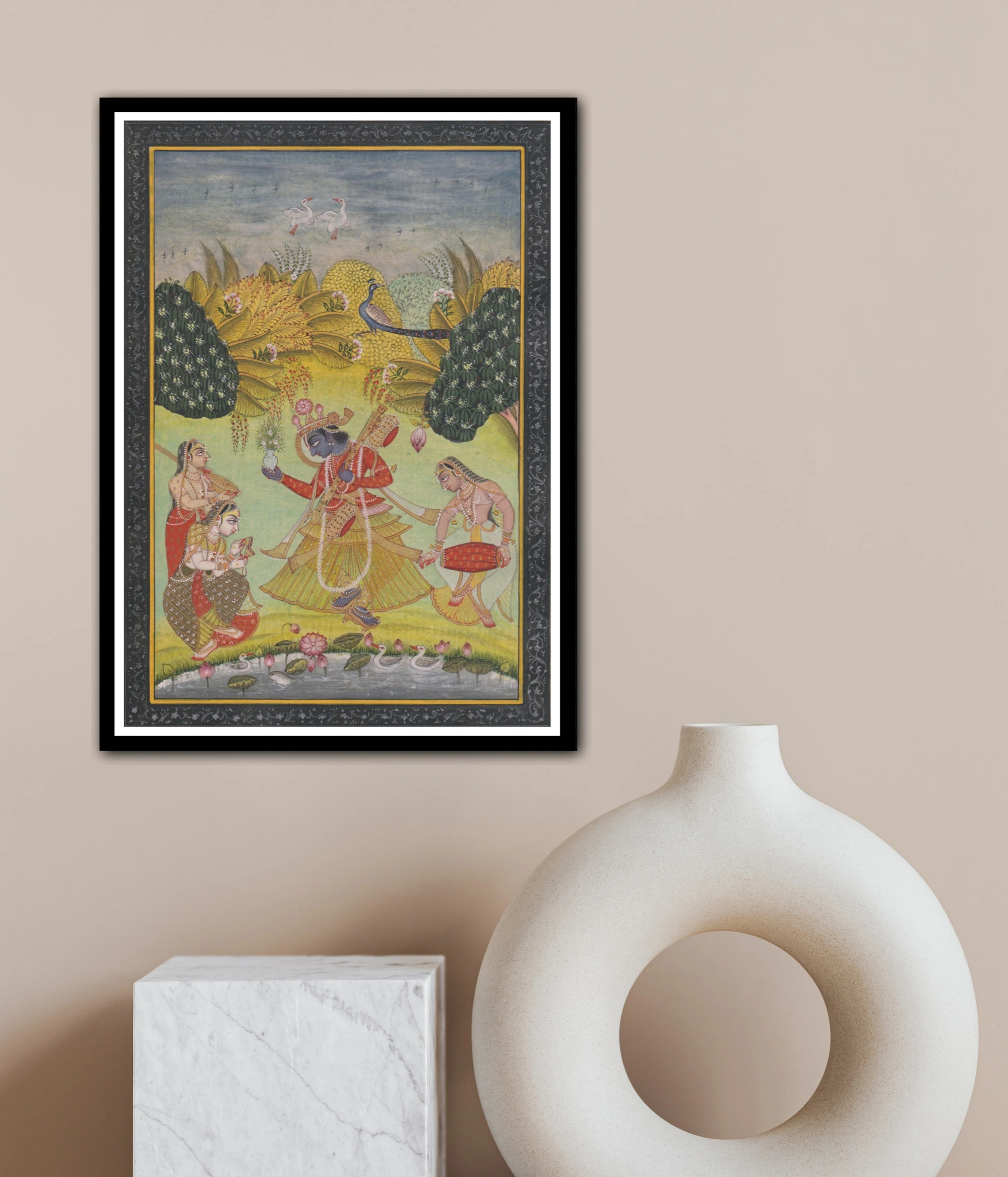
The Raas Leela
The circular dance of Krishna with Radha and the gopis, celebrated on Sharad Purnima, the full moon of autumn. These paintings are busy, joyful and full of movement, and they work best where people gather: a living room, dining area or entrance hall. Our Krishna dancing with the gopis miniature is a good example of the theme.
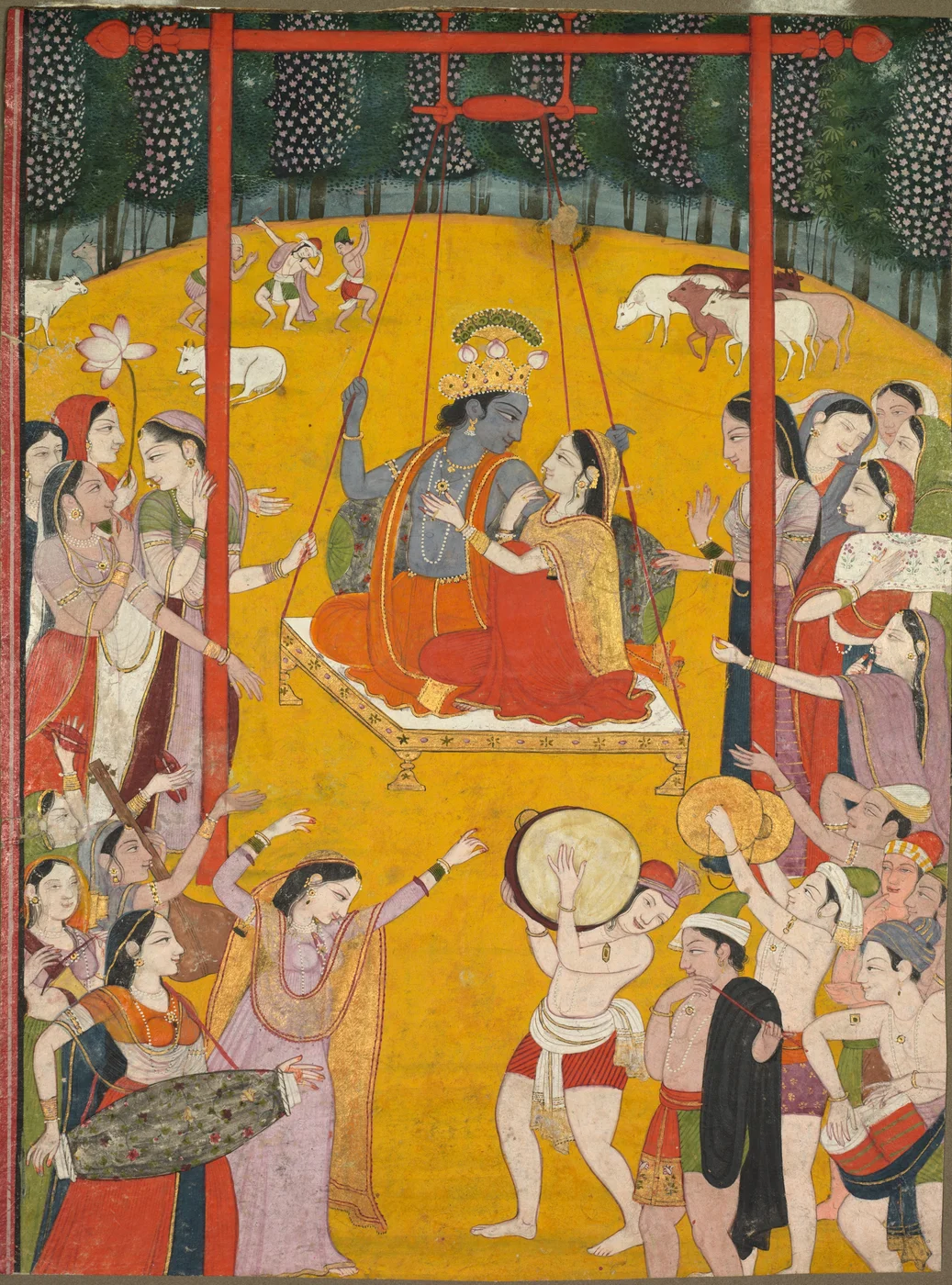
The swing (Jhulan or Hindola)
Radha and Krishna sit together on a decorated swing while friends play music and push it gently. The swing festival, Jhulan, falls in the monsoon month of Shravan, and in Pahari painting the scene also appears in Ragamala sets as Hindola Raga, a musical mode linked with young love in spring. Because the couple is shown together and at ease, swing scenes are a favourite for bedrooms.
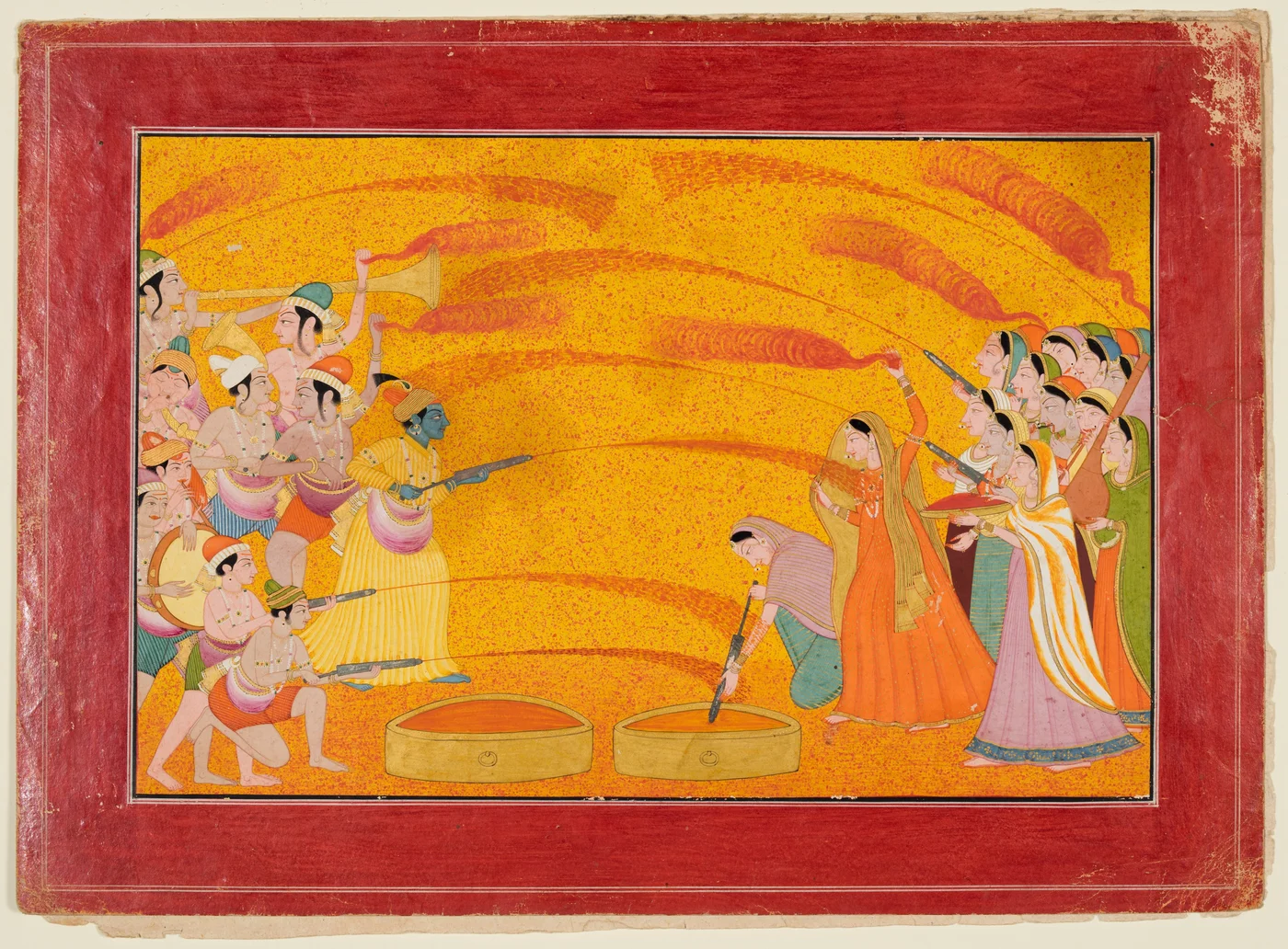
Holi in Braj
Krishna and the gopis spray coloured water and powder at each other in the spring festival of Holi. These paintings are bright and playful, perfect for a family room or a wall that needs energy.
Radha and Krishna together in a bower
The simplest and most intimate scene: the couple seated together under flowering trees, sometimes exchanging glances or a garland. If you want one painting for a married couple’s room, this is usually it. Our Radha Krishna in a bower is painted in the Pahari manner.
Choosing a painting style
The same story looks completely different depending on the school. Here is how the main styles compare:

| Style | What it looks like | Best for |
|---|---|---|
| Kangra | Soft greens and blues, graceful figures, deep landscapes | Bedrooms, calm living rooms |
| Basohli | Hot flat backgrounds, bold outlines, large expressive eyes | A single statement piece on a plain wall |
| Kishangarh | Elongated faces, almond eyes, refined romantic mood | Living rooms and formal spaces |
| Nathdwara | Krishna as Shrinathji, cows, lotuses, rich gold | Pooja rooms and entrances |
| Modern (acrylic, oil) | Simplified forms, larger canvases, contemporary colours | Modern apartments, offices |
If you are unsure, start with the room’s colours. Cool, pale walls suit Kangra; a white or grey wall can carry the heat of a Basohli piece; a traditional, wood-rich interior suits Kishangarh or Nathdwara. Read more about these schools in our guides to Pahari painting, Basohli painting and the Kishangarh style and Bani Thani.
Where to hang a Radha Krishna painting
In the bedroom
Couples most often choose a painting of Radha and Krishna together, such as the swing or a bower scene, for the bedroom. Choose a peaceful image: many families prefer to avoid scenes of separation or longing, which are common in miniature painting but carry a sadder mood. A medium painting above the headboard or on the wall you see first when you enter usually works best.

In the living room
The living room can take something larger and livelier, like a Raas Leela, a Holi scene or a group of two or three miniatures framed alike. Hang the centre of the painting roughly at eye level, about 145 to 155 cm from the floor, and leave a little breathing space around it.
In the pooja room or entrance
For a pooja room, devotional compositions such as Nathdwara-style Krishna work well. At the entrance, a cheerful scene welcomes guests. Wherever it goes, treat the painting with respect: keep it off the floor, away from bathrooms and shoe racks, and away from damp walls and direct sun.
What about Vastu?
Many people also follow Vastu Shastra when placing devotional art. Advice varies between practitioners, but common suggestions include keeping devotional images on clean, uncluttered walls, favouring the north or east side of living spaces, and choosing calm, happy scenes for bedrooms. Treat these as traditional guidance rather than rules, and above all choose an image that brings you peace when you look at it. Our guides to Vastu approved paintings and paintings to avoid at home go into more detail.
Size, framing and care
- Size to the wall: a painting about two thirds the width of the furniture beneath it looks balanced. Small miniatures look best grouped or framed with a wide mount.
- Framing: works on paper should be framed behind glass with an acid-free mount; canvas can be hung without glass.
- Light: keep the painting out of direct sunlight, which fades natural colours over time.
- Cleaning: dust the frame with a soft dry cloth and never spray cleaners on the painted surface.
Hand-painted or print?
Printed Radha Krishna canvases are cheap and everywhere, and they have their place. A hand-painted work is different: it is one of a kind, the colours have depth, and it can be handed down. To tell them apart, look closely at faces and jewellery. Paint shows tiny brushstrokes and slight variations, while prints break into a regular dot pattern. Gold that catches the light as you move is a good sign of real gold or gold paint.
Finding the right Radha Krishna painting
Our Radha Krishna paintings are all painted by hand, across several schools. A few to start with:

- Radha Krishna in Kishangarh style, for a refined, romantic living room piece.
- Radha Krishna in Kangra style, soft and calm, well suited to a bedroom.
- Radha Krishna love theme in Basohli style, a bold, affordable statement.
- Radha Krishna in Nathdwara style, with cows and lotuses, for a pooja room or entrance.
- Baramasa Sawan Month painting, Radha and Krishna under monsoon clouds.
Prices across the collection range from under ₹10,000 for smaller works to around ₹50,000 for larger, detailed pieces, so there is room for most budgets.
Frequently asked questions
A calm scene of Radha and Krishna together, such as the swing (Jhulan) or a bower scene, is the most popular choice. Many families avoid scenes of separation in the bedroom.
Bedrooms and living rooms are the most common places, along with pooja rooms and entrances. Hang it at eye level on a clean wall, away from bathrooms, shoe racks, damp and direct sunlight.
Many people consider it an auspicious image for the home. Vastu advice varies between practitioners; common suggestions are calm scenes for bedrooms and clean, uncluttered walls on the north or east side of living spaces.
It symbolises devoted love. In Vaishnava tradition, Radha’s love for Krishna stands for the soul’s love for the divine.
The Raas Leela is Krishna’s circular dance with Radha and the gopis of Braj, celebrated on Sharad Purnima, the full moon of autumn.
It depends on your room. Kangra is soft and calm, Basohli bold and dramatic, Kishangarh refined and romantic, and Nathdwara devotional and rich in gold. Modern acrylic styles suit contemporary interiors.
