
Indian Art
Phad Painting of Rajasthan: History, Stories and How to Recognise It

Oct
Quick answer: Phad painting is a folk scroll painting tradition of Rajasthan, centred on Shahpura and Bhilwara. Painted on long cloth scrolls with natural colours, a Phad tells the stories of folk deities such as Pabuji and Devnarayan, and was traditionally performed at night by Bhopa priest-singers. It is known for flat bright colours, bold outlines and crowded, lively storytelling.
What is Phad painting?
The word phad is commonly linked to “fold”, because these long painted cloths are rolled or folded and carried from village to village. A traditional Phad is a portable temple: when it is unrolled at night, the Bhopa (a singer-priest) and his companion sing the deity’s epic, pointing to each scene with a lamp, often accompanied by the ravanhattha, a bowed string instrument.

A short history of Phad art
Phad painting has been practised for centuries in the Mewar region of Rajasthan, especially around Shahpura in Bhilwara district. The art has long been associated with the Joshi families of painters, who passed down techniques, compositions and stories from one generation to the next. In modern times, master artists such as Shree Lal Joshi, honoured with the Padma Shri, helped bring Phad from village performances to museums, exhibitions and homes around the world.

Stories painted on a Phad
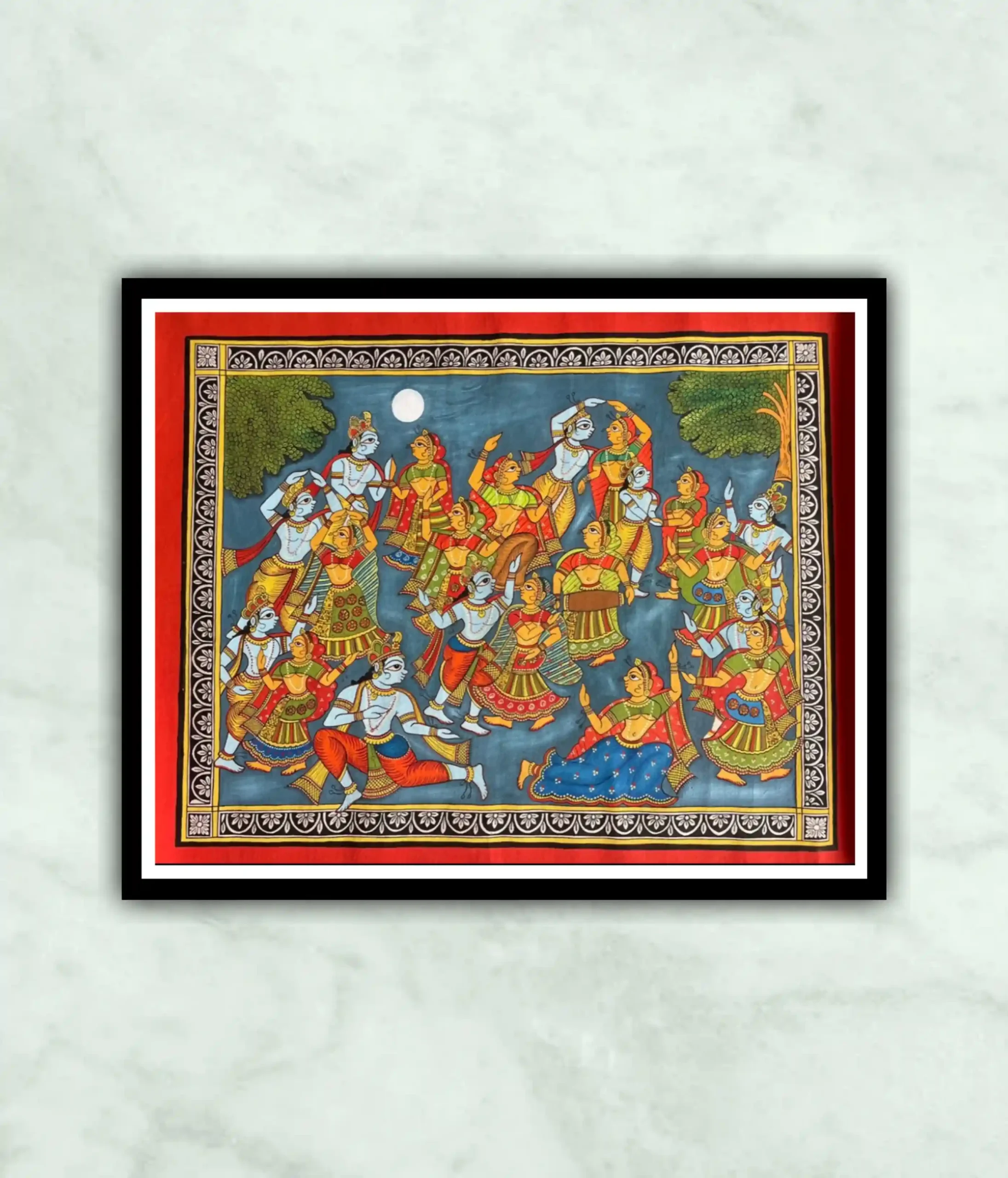
- Pabuji ki Phad: the story of Pabuji, a folk hero and deity revered for protecting his people and their cattle.
- Devnarayan ki Phad: the epic of Devnarayan, worshipped especially by the Gujjar community, and among the longest Phad scrolls.
- Ramayana, Krishna Leela and village life: modern Phad artists also paint mythology, the Raas Leela, royal processions, music and dance, and pastoral scenes with cows.
How to recognise a Phad painting

- Flat, bright colours such as yellow, orange, red, green and blue, with no shading or perspective.
- Bold black outlines that define every figure.
- The hero is the largest figure, usually at the centre, with smaller figures arranged around him.
- Figures face each other in profile, filling the surface edge to edge with action.
- Natural pigments, traditionally made from minerals and plants.
Phad vs other Indian folk paintings
| Phad | Madhubani | Warli | |
|---|---|---|---|
| Region | Rajasthan | Mithila, Bihar | Maharashtra |
| Look | Bright flat colours, bold outlines, narrative scrolls | Dense patterns, double outlines, nature motifs | White figures of circles and triangles on earthy ground |
| Purpose | Portable shrine for sung epics | Ritual wall and floor art | Ritual and everyday life on village walls |
Read more about famous Madhubani paintings, Warli art and the types of Indian paintings.
Bringing Phad art home
A Phad painting adds instant colour and story to a living room, hallway or office. Smaller Phad panels painted on paper are easy to frame and make memorable gifts. Our artists hand-paint Phad style works with natural pigments, including the Folk Dance Phad painting, Raas Leela Phad, Cows Phad and King and Queen in the garden. Browse the full collection of Phad paintings and other Rajasthani paintings.

How a traditional Phad is made
Making a Phad is slow, careful work, and much of the process is still done by hand:
- Preparing the cloth: a length of coarse cotton cloth is soaked and stiffened with a starch paste, then rubbed smooth with a stone so the colours sit evenly on the surface.
- Grinding the colours: colours come from natural minerals and plants, ground by hand and mixed with a natural gum as binder.
- Planning the story: the painter lays out the epic across the cloth, with the deity or hero at the centre and the episodes of the story around him.
- Painting in layers: colours are applied one at a time across the whole composition, rather than finishing one figure at a time.
- Black outlines: bold black lines are added last, giving Phad its crisp, graphic look.
Colour and symbolism in Phad
- Size shows importance: the hero or deity is painted larger than everyone else.
- Bright, flat colours: warm yellows and oranges, earthy reds, greens for trees and blues for water create energy and clarity, so the story can be read by lamp light.
- Faces in profile with large eyes look towards each other, linking scenes together.
- No empty space: every part of the cloth is filled with people, animals, buildings and patterns.
The performance: Bhopas and the night-long jagran
A traditional Phad is not meant to hang quietly on a wall. It is a portable shrine. The Bhopa, a priest-singer, and often his wife (the Bhopi) unroll the Phad after sunset in a village. As they sing the epic through the night, the Bhopi lifts a lamp to light each scene, and the Bhopa plays the ravanhattha. The performance, called a jagran, is a form of worship as well as entertainment. When a Phad grows too old to use, it is traditionally retired with ritual respect.

Phad today
Over the last few decades, Phad artists have adapted the tradition for new audiences. Alongside full-length scrolls, they now paint smaller panels on cloth and paper, and new subjects such as the Ramayana, Krishna’s Raas Leela, village life, royal gardens, music and dance. This has helped the art form survive and reach homes, galleries and collectors around the world, while the core visual language stays the same.

Phad vs Pichwai: what’s the difference?
| Phad | Pichwai | |
|---|---|---|
| Origin | Shahpura and Bhilwara, Rajasthan | Nathdwara, Rajasthan |
| Purpose | Portable shrine for sung epics of folk deities | Temple hanging behind the image of Shrinathji |
| Subjects | Pabuji, Devnarayan, folk heroes, village life | Krishna as Shrinathji, cows, lotus, festivals |
| Look | Flat bright colours, bold outlines, crowded narrative | Rich, decorative, often with gold and lotus patterns |
Explore devotional Nathdwara art in our Nathdwara paintings collection.
How to spot an authentic hand-painted Phad
- Visible brushwork and slight variations in line thickness.
- Natural, matte colours rather than glossy printed ink.
- Hand-drawn black outlines that are confident but not mechanically perfect.
- Clear details from the seller about size, colours and surface.
Caring for a Phad painting
Keep Phad paintings away from direct sunlight and damp walls. Paper Phads are best framed behind glass; cloth Phads can be framed or hung from a rod. Dust gently with a soft, dry cloth and never use water or cleaning sprays on the painted surface.
Glossary of Phad terms
- Phad: the painted cloth scroll itself, carried and unrolled for performance.
- Bhopa and Bhopi: the priest-singer and his partner who perform the epic in front of the Phad.
- Jagran: the night-long performance and worship in which the Phad is sung.
- Ravanhattha: a bowed string instrument played by the Bhopa during the performance.
- Pabuji: a folk hero and deity of Rajasthan whose story is one of the most painted Phads.
- Devnarayan: a folk deity worshipped especially by the Gujjar community, whose epic forms one of the longest Phads.
- Joshi family: the painter families of Shahpura and Bhilwara who have kept the Phad tradition alive for generations.
Phad paintings as gifts
A small Phad panel is a colourful, story-rich gift that suits housewarmings, corporate gifting and anyone who loves Indian folk art. Each piece is painted by hand, so it carries the spirit of the tradition rather than being a mass-produced print. For corporate or bulk orders, see our corporate gifting page, or browse all Phad paintings.
The story of Pabuji in brief
The epic of Pabuji is one of the most important stories painted on a Phad. As it is commonly told, Pabuji Rathore was a Rajput hero who borrowed a beautiful black mare, Kesar Kalmi, from a woman named Deval, promising in return to protect her cattle. On the day of his wedding, word came that her cows had been stolen. Pabuji left the ceremony, rode out to rescue the herd and gave his life keeping his promise. He came to be worshipped as a protector of cattle and of the people who depend on them.
On a Pabuji Phad, Pabuji is the largest figure, usually shown on his mare at the centre of the cloth, surrounded by the episodes of his life: his birth, his companions, his wedding, the chase and the battle. Reading a Phad is like reading a giant comic book, and the Bhopa’s song tells you which scene to look at next.
The epic of Devnarayan is also widely sung, especially by the Gujjar community. It is so long that a full performance can take many nights, and its Phads are among the longest scrolls made.
Frequently asked questions
A folk scroll painting from Rajasthan that tells the epics of folk deities like Pabuji and Devnarayan, painted with flat bright colours and bold outlines.
It comes from Rajasthan, especially Shahpura and the Bhilwara district.
The Joshi family of painters is most closely associated with Phad, and Shree Lal Joshi is among its best-known modern masters.
Traditionally, Bhopa priest-singers unroll the scroll at night and sing the deity’s story, using the painting as a travelling shrine.
Bright natural colours such as yellow, orange, red, green and blue, outlined in black.
Cotton cloth is stiffened with starch and polished smooth, natural colours are applied one at a time across the whole composition, and bold black outlines are added last.
Phad is a folk scroll from Shahpura and Bhilwara used to sing epics of folk deities; Pichwai is a Nathdwara temple hanging devoted to Shrinathji.
Bhopas are priest-singers who unroll the Phad at night and perform the deity’s epic, often with the Bhopi lighting each scene with a lamp.
