
Indian Art
Pichwai Painting: History, Meaning, Motifs and How to Identify It

Oct
Quick answer: Pichwai is a devotional painting tradition from Nathdwara in Rajasthan. A pichwai is a large painted cloth hung behind the idol of Shrinathji, the child form of Lord Krishna, and is changed with the seasons and festivals. Pichwai paintings are known for lotus ponds, cows, gopis, peacocks, rich gold borders and natural colours, and today they are loved as wall art across India and the world.
What is Pichwai painting?
The word pichwai (also spelt pichhwai or pichhvai) comes from two Hindi words: pichh, meaning “back”, and wai, meaning “hanging”. A pichwai is literally a “back hanging”: a painted cloth placed behind the deity in the temple. Unlike a painting made for a palace wall, a pichwai is a working part of worship. It sets the scene for the deity, shows the season or festival being celebrated, and tells devotees a story about Krishna at a single glance.

Pichwai art belongs to the town of Nathdwara in Rajsamand district, about 50 km from Udaipur. The town grew around the temple of Shrinathji, and generations of painters settled nearby to serve it. That is why pichwai is often called Nathdwara painting, and why you will find it listed among the schools of Rajasthani painting.
Which state is Pichwai painting from?
Pichwai painting is from Rajasthan. Its home is Nathdwara, a temple town in the Mewar region of southern Rajasthan. Painters’ families there have practised the art for more than three centuries, and the lanes around the temple are still full of studios. Pichwai styles are also made in Udaipur and other cities today, but Nathdwara remains the heart of the tradition.
The history of Pichwai art
Pichwai is tied to the Pushtimarg (the “path of grace”), a Krishna devotional sect founded by the saint Vallabhacharya around the late 15th and early 16th centuries. Followers worship Krishna as a beloved child, and they serve him with food, music, clothing and art through the day. The deity at the centre of this worship is Shrinathji, a form of Krishna as a seven-year-old child lifting Mount Govardhan with his raised left hand.
The idol of Shrinathji was first worshipped near Govardhan in the Braj region. In the 17th century, during the reign of the Mughal emperor Aurangzeb, priests carried the idol away to keep it safe. According to tradition, the chariot carrying it stuck in the mud at a village called Sihad in Mewar, and this was taken as a sign that the Lord wished to stay. A temple was built there around 1672 with the support of the Mewar rulers, and the village became Nathdwara, “the gateway to the Lord”.
Painters followed the deity, and an entire art industry grew around the temple. Over time pichwais became more elaborate, with fine faces, layered landscapes and real gold. Today they are collected by museums and design lovers, and smaller pichwai style works on paper, canvas and wood are made for homes.
Shrinathji: the heart of every Pichwai
Most traditional pichwais are made for Shrinathji or show him. You can recognise him by a few features: a dark blue or black body, large almond-shaped eyes, his left hand raised (lifting Govardhan), his right hand resting on his waist, and rich jewellery and garments. He is often shown standing in the temple with priests, devotees and the gopis around him.
In the Pushtimarg temple (called a haveli, because it is designed like a home rather than a grand temple), the deity’s clothing, decoration and backdrop change many times a day and through the year. Pichwais are part of this shringar or adornment. A white pichwai with cool colours might be used in summer, while bright, festive pichwais appear for Diwali and Holi.
Pichwais for seasons and festivals
Because each pichwai is made for a moment in the temple calendar, its subject usually tells you the season or festival. Some of the best-known themes are:
- Janmashtami and Nand Mahotsav: the birth of Krishna and the celebrations in Gokul.
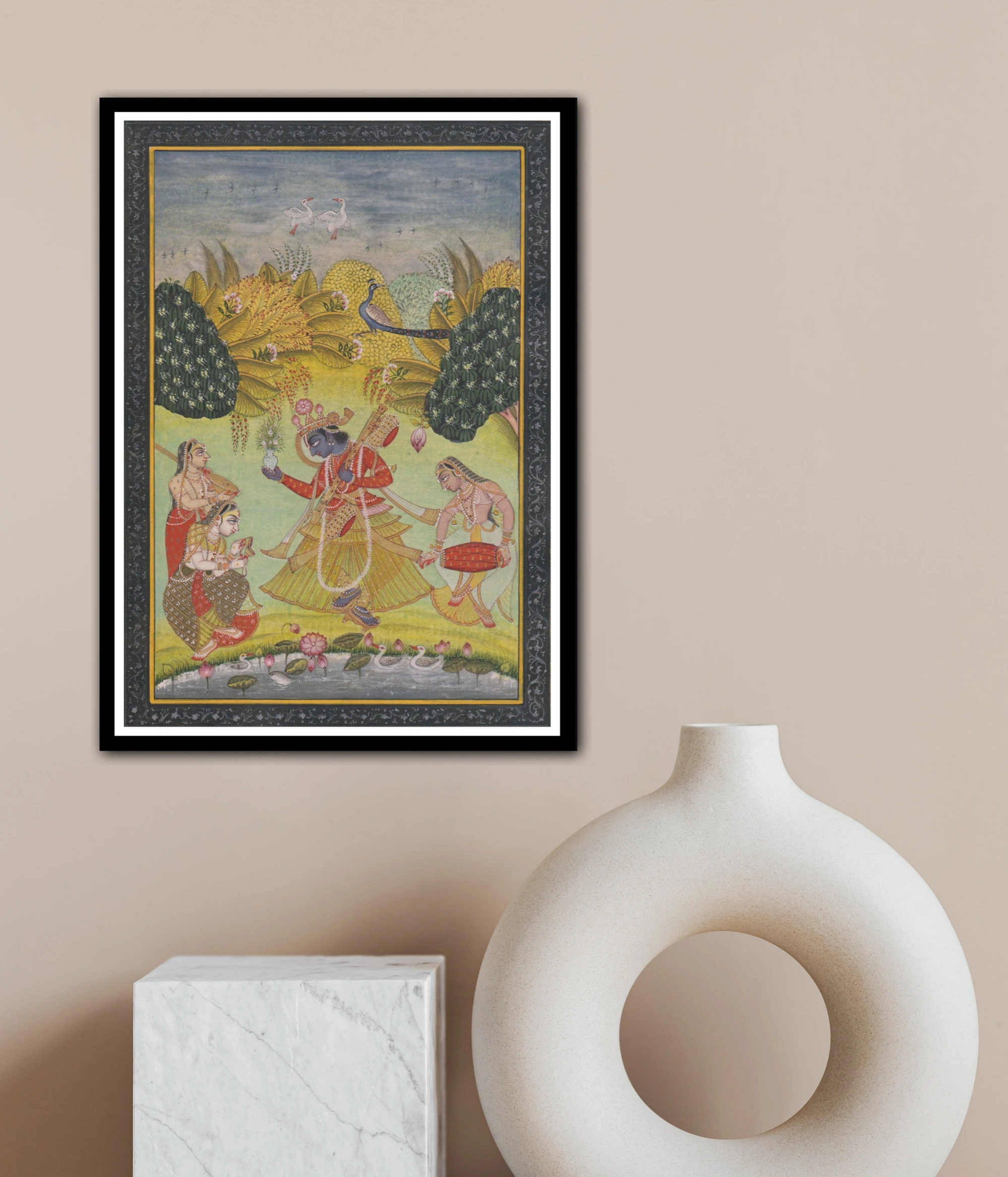
- Sharad Purnima and Raas Leela: Krishna dancing with the gopis under the full autumn moon.
- Annakut (Govardhan Puja): a mountain of food offered to the deity the day after Diwali.
- Gopashtami: Krishna as the cowherd, with cows and calves, celebrating his first day herding cattle.
- Kamal Talai (lotus pond): a cool pond full of pink lotuses, used in the hot summer months.
- Holi and Phool Mandali: spring scenes with colours, flowers and music.
- Monsoon (Varsha): dark clouds, lightning, peacocks and rain, the season of longing in Indian art.
Our Krishna dancing with the gopis painting shows the Raas Leela, one of the favourite themes of Krishna art across Rajasthan.
Common Pichwai motifs and their meaning
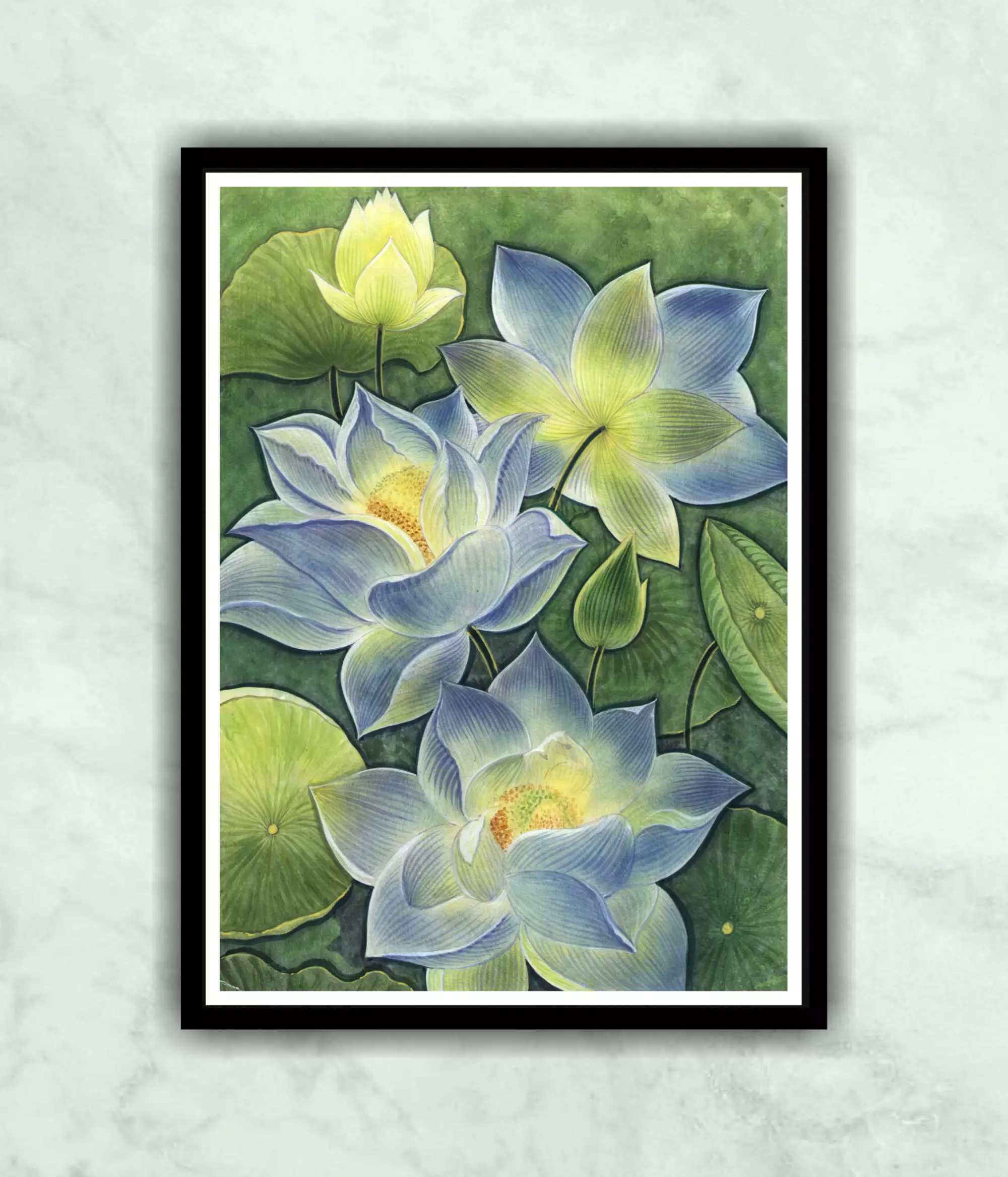
- Lotus: the most loved pichwai motif. The lotus stands for purity, beauty and divine love, and a pond of lotuses is believed to cool and delight the child Krishna in summer.
- Cows (Kamdhenu): Krishna is Gopala, the protector of cows. Decorated cows with calves, bells and painted horns symbolise abundance, motherhood and blessings. Cow pichwais are among the most popular for homes.
- Gopis: the milkmaids of Braj stand for the soul’s devotion to Krishna. They are shown in rows, holding lamps, fans, flowers and offerings.
- Peacocks: Krishna wears a peacock feather in his crown. Peacocks also signal the monsoon and joy.
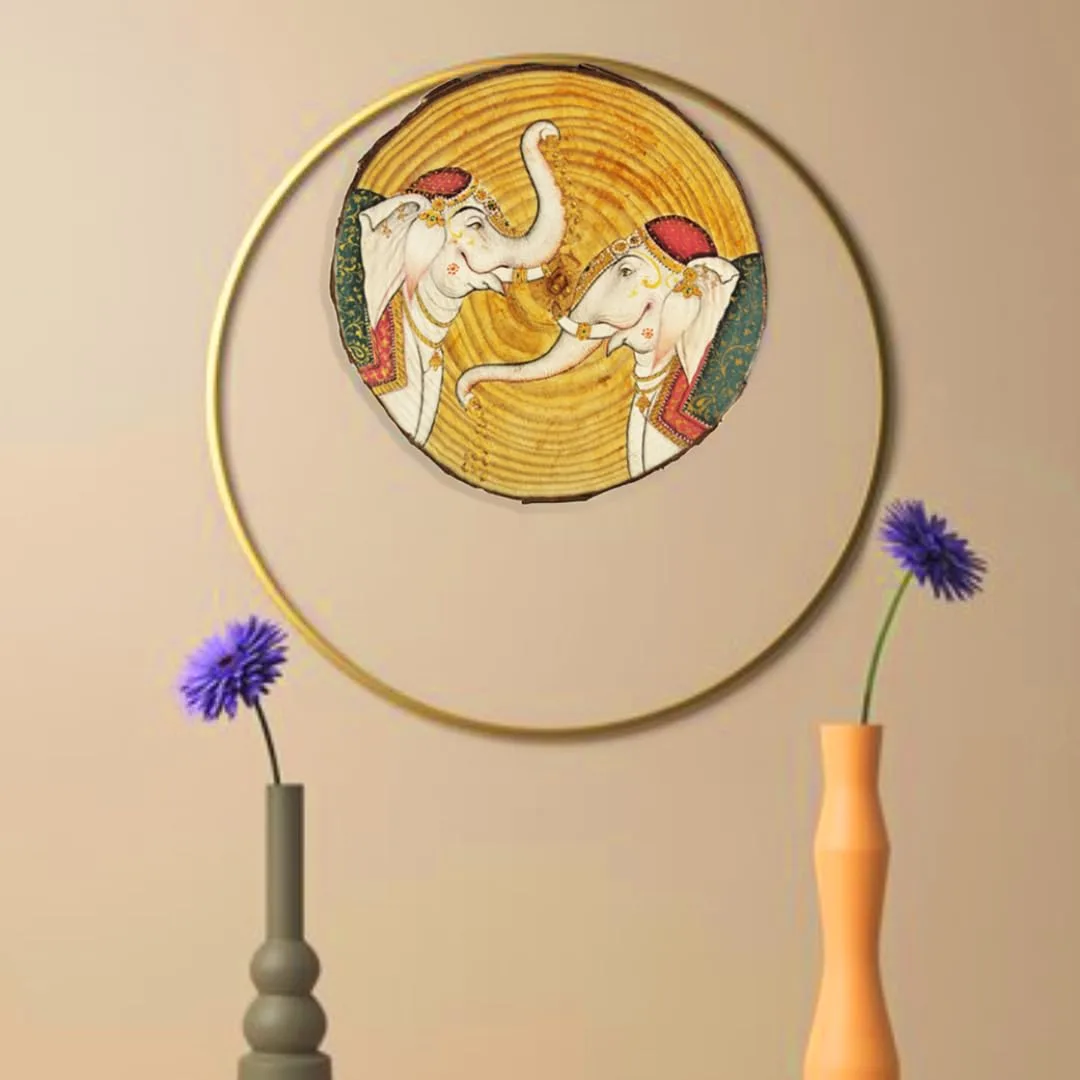
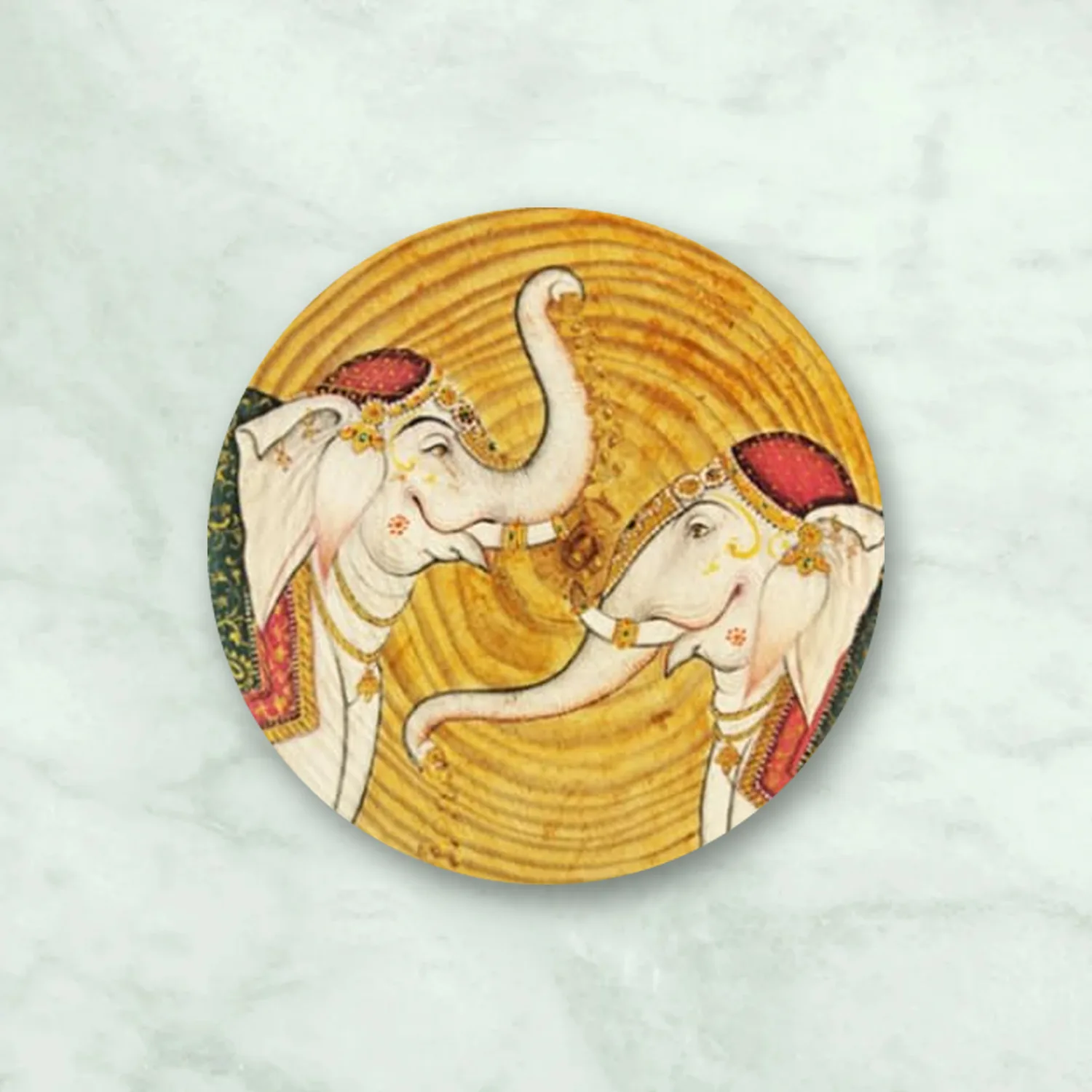
- Elephants: royal, decorated elephants symbolise strength, prosperity and royal patronage, a nod to the Mewar court.
- Trees, banana plants and the Yamuna: the green world of Braj where Krishna grew up.
- Full moon and night sky: the setting of the Raas Leela on Sharad Purnima.
How a traditional Pichwai is made

- Preparing the cloth: a cotton cloth is treated, stretched and polished so that it can take fine detail.
- Drawing: the master artist draws the composition, often using a light outline in charcoal or a pale colour.
- Grinding colours: traditional colours are made from natural minerals, stones and plants, ground by hand and mixed with gum. Real gold and silver are used for jewellery, borders and highlights.
- Filling colours: large areas such as the sky, water and ground are painted first, then figures, cows and flowers.
- Fine details: faces, eyes, jewellery and textiles are finished with very fine brushes, often by the most senior painter.
- Burnishing: the surface may be polished to bring out a soft glow in the colours and gold.
A large, detailed pichwai can take a team of painters weeks or months. That is why genuine hand-painted pichwais cost far more than prints. If you would like to try the technique, our natural stone colours pack uses the same kind of pigments, and our miniature painting classes teach the brushwork step by step.
Colours used in Pichwai painting
Traditional pichwais use rich, natural colours: deep indigo and black for Shrinathji and night skies, vermilion red and saffron for garments and borders, leaf green for trees and banana plants, white and pink for lotuses and cows, and gold for jewellery, borders and light. Many modern pichwai style artworks use acrylic or watercolour on paper or canvas, which is more affordable and easier to frame, while keeping the classic palette.
Pichwai vs Phad vs Tanjore: what’s the difference?
| Pichwai | Phad | Tanjore | |
|---|---|---|---|
| Region | Nathdwara, Rajasthan | Shahpura and Bhilwara, Rajasthan | Thanjavur, Tamil Nadu |
| Purpose | Temple backdrop for Shrinathji | Travelling scroll for sung epics of folk deities | Devotional icon painting for home shrines |
| Surface | Cloth (today also paper, canvas, wood) | Long cotton scroll | Wooden board with cloth |
| Look | Lotus ponds, cows, gopis, fine faces, gold | Flat bright colours, bold outlines, crowded scenes | Raised gesso work, gold foil, inset glass stones |
| Main subject | Krishna as Shrinathji | Pabuji, Devnarayan | Krishna, Ganesha, Lakshmi and other deities |
Read our guides to Phad painting, Tanjore paintings and the wider types of Indian paintings.
Pichwai painting in home decor
Pichwai art has become a favourite of interior designers because it brings colour, calm and a sense of the sacred into modern homes. Here are some ideas:
- Living room: a large lotus or cow pichwai above the sofa becomes an instant focal point.
- Pooja room or mandir: a Shrinathji or Krishna pichwai behind the altar recreates the temple setting.
- Entrance and hallway: a pair of cow or elephant panels welcomes guests with symbols of prosperity.
- Bedroom: soft lotus pond designs in white, pink and green feel calm and restful.
- Small spaces: round pichwai plates and small panels can be grouped into a gallery wall or placed on a shelf.
For example, our hand-painted Pichwai elephant wall plate brings a royal pichwai elephant to a small round wooden plate that you can hang or place on a stand. You can also explore more ideas in our guide to the best paintings for the living room.
Is Pichwai painting good for Vastu?
Many families choose pichwai paintings for their positive symbols. Cows are linked with abundance and motherly blessings, lotuses with purity and Goddess Lakshmi, and Krishna with love and joy. In popular Vastu advice, devotional paintings are often placed in the north-east or in the pooja room, and cheerful, auspicious images are preferred over sad or violent scenes. Read our guides to Vastu approved paintings and paintings to avoid at home for more tips.
How to spot an authentic hand-painted Pichwai
- Look closely at the faces and eyes: hand-painted faces have fine, slightly varied lines; prints look flat and pixelated up close.
- Check the edges of colour: real paint sits on the surface and may show tiny brush marks; printed colour soaks evenly into the fabric or paper.
- Gold work: real gold or gold paint catches the light from different angles; printed gold looks the same from every side.
- Repetition: in a print, every cow and lotus is identical; in a hand painting, each one is slightly different.
- Price and time: a detailed hand-painted pichwai takes days or weeks. An unusually cheap “hand-painted” piece is often a print with a little paint added.
- Ask the seller: a genuine seller can tell you the artist, medium and size, and can show close-up photos.
Pichwai painting price guide
Prices vary widely with size, detail, surface and the artist’s skill. As a general guide, small pichwai style decor pieces such as plates and small panels cost a few thousand rupees, medium paintings on paper or canvas can cost from several thousand to tens of thousands, and large, finely detailed temple-style pichwais by master artists can cost lakhs. Always compare like with like: a large hand-painted cloth pichwai is a very different object from a printed canvas of the same size.
Caring for a Pichwai painting
Keep your pichwai out of direct sunlight, which fades natural colours, and away from damp walls and kitchens. Paintings on paper should be framed behind glass with an acid-free mount. Cloth pichwais can be framed or hung from a rod, and should be rolled (never folded) for storage. Dust gently with a soft, dry brush and never use water or cleaning sprays on the painted surface.
Glossary of Pichwai terms
- Pichwai / Pichhwai: a painted cloth hung behind the deity.
- Shrinathji: the child form of Krishna lifting Govardhan, worshipped at Nathdwara.
- Pushtimarg: the Krishna devotional path founded by Vallabhacharya.
- Haveli: a Pushtimarg temple, designed like a home.
- Shringar: the daily and seasonal adornment of the deity.
- Kamal Talai: a lotus pond pichwai used in summer.
- Annakut: the festival of a mountain of food offered after Diwali.
- Gopashtami: the festival of Krishna as cowherd.
Buy hand-painted Pichwai and Nathdwara style art
At Artshaili, our artists hand-paint Indian art with natural colours and fine brushes. Explore our Nathdwara paintings, including Radha Krishna in Nathdwara style with cows and trees, our Blue Lotus miniature painting, the Pichwai elephant wall plate and our full range of Radha Krishna paintings. Want a custom size or theme? Contact us and our artists will be happy to help.
Frequently asked questions
Pichwai is a devotional painting from Nathdwara, Rajasthan, made on cloth to hang behind the idol of Shrinathji, the child form of Krishna. It shows Krishna’s life, seasons and festivals with lotuses, cows, gopis and gold.
Pichwai painting is from Rajasthan, centred on the temple town of Nathdwara near Udaipur.
It comes from “pichh” (back) and “wai” (hanging), so it means a hanging placed at the back, behind the deity.
Lord Krishna, mainly in his form as Shrinathji, a seven-year-old child lifting Mount Govardhan with his left hand.
Krishna is Gopala, the protector of cows. Cows symbolise abundance, motherhood and blessings, and cow pichwais celebrate festivals like Gopashtami.
The lotus stands for purity, beauty and divine love. Lotus pond (Kamal Talai) pichwais were used in summer to cool and delight the child Krishna.
Pichwai is a temple backdrop from Nathdwara devoted to Shrinathji, while Phad is a long folk scroll from Shahpura and Bhilwara used to sing the epics of folk deities like Pabuji and Devnarayan.
Traditionally natural mineral and plant colours with real gold and silver. Many modern works use acrylic or watercolour in the same classic palette.
Living rooms, entrances and pooja rooms are popular. Many families follow Vastu advice and place devotional art in the north-east or in the pooja room.
Look for slight differences between repeated motifs, fine varied lines on faces, visible brush texture and gold that changes with the light. Prints look perfectly uniform up close.
