
Indian Art
Mughal Miniature Paintings: History, Features and Famous Works

Oct
Quick answer: Mughal miniature painting is the court painting style of the Mughal emperors of India, which flourished from the mid-16th to the 18th century. It blended Persian refinement with Indian subjects and naturalism. It is known for detailed court scenes, realistic portraits, and exquisite studies of birds, animals and flowers framed by ornate borders.
A short history of Mughal painting
Mughal painting began when Emperor Humayun brought the Persian masters Mir Sayyid Ali and Abd al-Samad to India in the mid-16th century. Under each emperor that followed, the style took on a different character:

- Akbar built a large royal workshop where Persian and Indian artists worked together. He commissioned ambitious illustrated manuscripts such as the Hamzanama, the Akbarnama and the Razmnama (a Persian Mahabharata). Painters such as Basawan and Daswanth became famous in this period.
- Jahangir loved nature and portraiture. His artists, above all Ustad Mansur, painted birds, animals and flowers with almost scientific accuracy, while Abu’l Hasan excelled at portraits.
- Shah Jahan‘s reign brought formal, jewel-like portraits and grand court scenes, as seen in the illustrated Padshahnama.
- From the late 17th century, imperial patronage declined. Many artists moved to Rajput and Pahari courts, where Mughal techniques shaped new regional styles such as Rajasthani and Pahari painting.
Features of Mughal miniature painting

- Naturalism: lifelike faces, animals, birds and plants, observed from nature.
- Portraits in profile or three-quarter view, often of emperors, nobles and ladies of the court.
- Court and garden scenes: darbars, hunts, celebrations and quiet moments in formal gardens.
- Ornate borders (hashiya) decorated with floral patterns and gold.
- Fine brushwork with very thin brushes, layered mineral colours and gold highlights.
- Persian influence in composition, colour harmony and calligraphy.
Popular subjects in Mughal paintings
The most loved Mughal themes are still painted by traditional artists today:
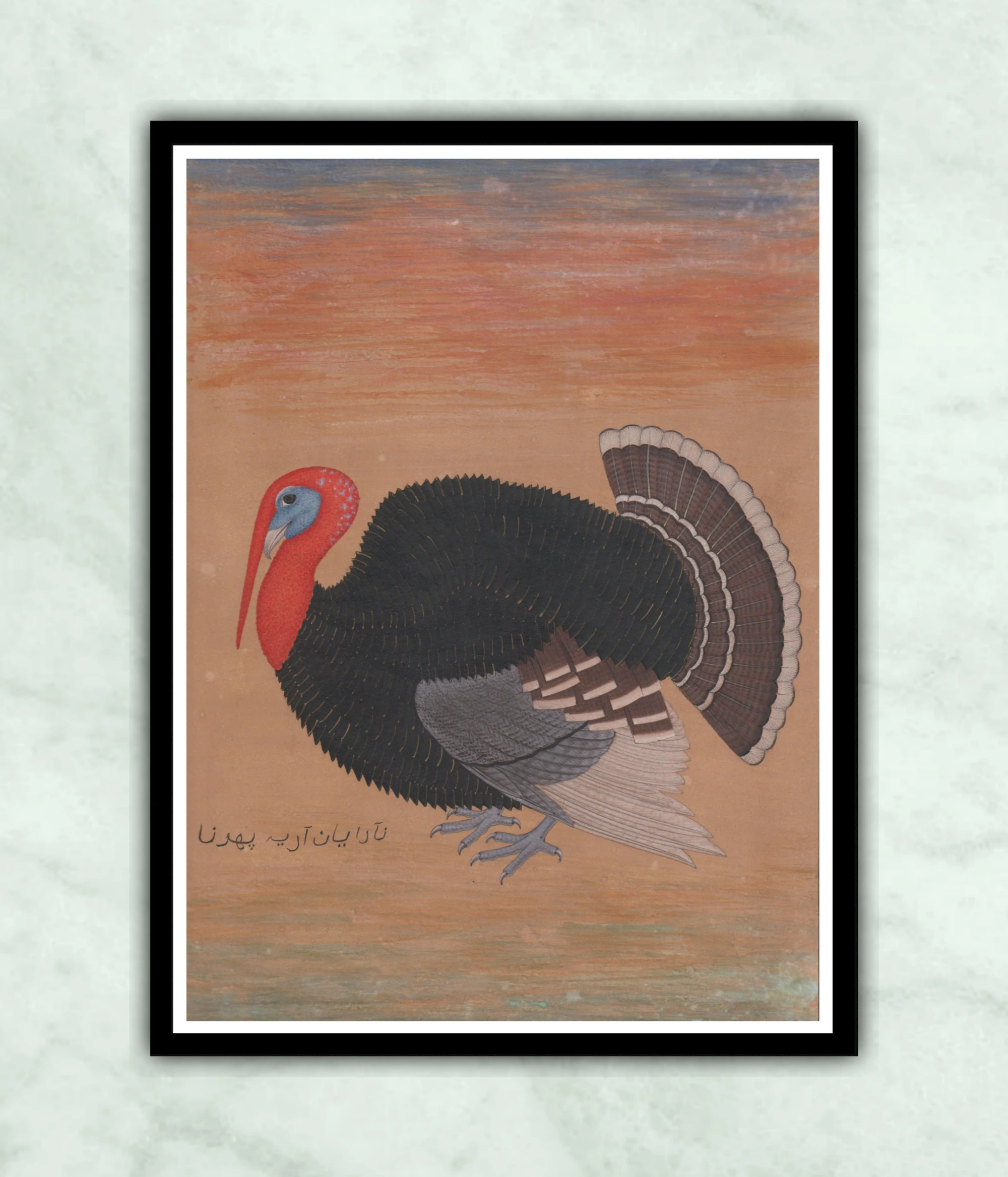
- Birds and animals, in the tradition of Ustad Mansur, such as our Mughal turkey cock painting and Mughal bird painting.
- Royal portraits, like the portrait of Shah Jahan in Mughal style.
- Court scenes and gatherings, such as The Council Beneath the Wisdom Tree and the Mughal court miniature painting.
- Flowers and nature studies, often painted as single specimens against a plain ground.
Mughal vs Rajasthani vs Pahari painting

| Mughal | Rajasthani | Pahari | |
|---|---|---|---|
| Patrons | Mughal emperors | Rajput kings of Rajasthan | Hill kingdoms of the Himalayan foothills |
| Mood | Realistic, courtly, observational | Bold, colourful, devotional and heroic | Lyrical, romantic, delicate |
| Favourite subjects | Court life, portraits, nature studies | Krishna, ragamala, hunts, royal portraits | Radha Krishna, Gita Govinda, nayikas |
| Colour | Subtle, harmonious, with gold | Strong primary colours | Soft, cool tones (Kangra) or bold (Basohli) |
For an overview of every major style, read our guide to the types of Indian paintings.
How to choose a hand-painted Mughal painting
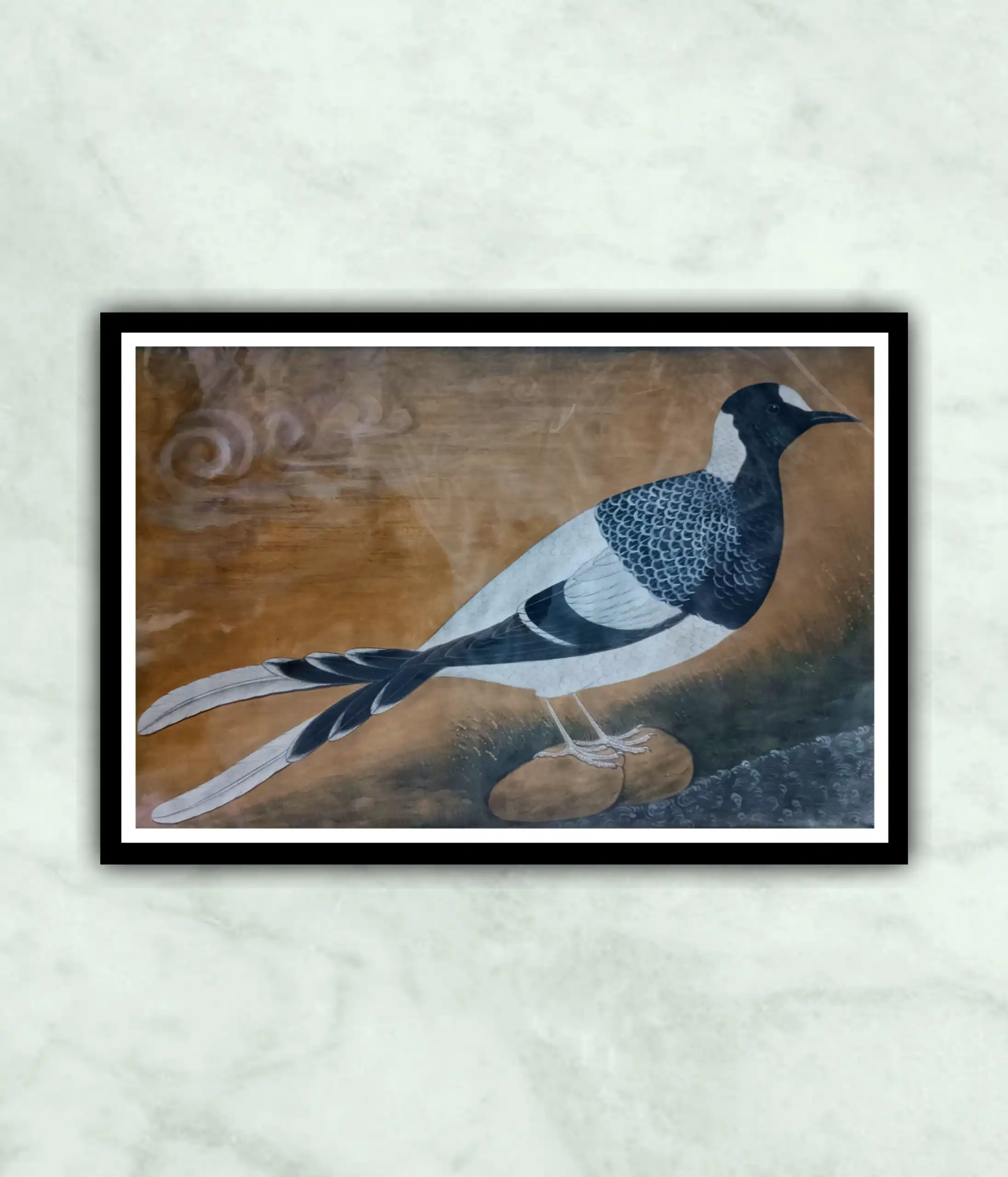
- Look closely at the detail: in a genuine hand-painted miniature you can see individual hair-fine brush strokes in feathers, jewellery and borders.
- Check the materials: traditional works use stone and mineral colours, often with real gold.
- Choose the subject for the room: birds and flowers suit living rooms and studies; court scenes make a statement in hallways and offices.
- Frame it well: a simple frame with a wide mount lets the fine detail breathe.
Explore our full collection of hand-painted Mughal paintings and all Indian miniature paintings.
Mughal painting under each emperor
Humayun (the beginning)
During his exile, Humayun spent time at the Persian Safavid court and invited the painters Mir Sayyid Ali and Abd al-Samad to join him. When he regained his throne in India, they became the founders of a new imperial studio.
Akbar (1556 to 1605): the great workshop
Akbar built a large atelier of more than a hundred artists, Persian and Indian, Hindu and Muslim. Work was often shared: one artist drew the composition, another painted faces, a third added colour. This produced lively, crowded narrative pages for epic projects such as the Hamzanama, the Akbarnama (the official history of his reign) and the Razmnama, a Persian translation of the Mahabharata.
Jahangir (1605 to 1627): nature and portraiture
Jahangir preferred single, perfect paintings for his albums over large group projects. He had a scientist’s curiosity about nature and asked his artists to record rare birds, animals and flowers. Ustad Mansur’s studies, such as his famous turkey cock and zebra, are among the finest natural history paintings ever made. Jahangir also loved allegorical portraits showing himself as a just and powerful ruler.
Shah Jahan (1628 to 1658): jewel-like perfection
Under Shah Jahan, the builder of the Taj Mahal, painting became formal, symmetrical and luxurious, with brilliant colours, lavish gold and elaborately decorated borders. The illustrated Padshahnama records the court ceremonies of his reign in astonishing detail.
Aurangzeb and later
Imperial patronage of painting declined under Aurangzeb. Many painters moved to Rajput, Pahari and Deccani courts, which is why Mughal precision shows up in so many regional styles. A later revival under Muhammad Shah in the 18th century produced elegant, romantic court scenes.
Materials and techniques
- Paper: handmade paper, often layered into a stiff card and burnished smooth.
- Brushes: extremely fine brushes, traditionally made from squirrel or kitten hair, sometimes with just a few hairs for the finest details.
- Colours: mineral and plant pigments ground by hand, including lapis lazuli for blue, malachite for green and natural earths for reds and yellows.
- Gold and silver: applied as fine powder or leaf, then burnished to shine.
- Burnishing: the painted surface is polished with a smooth stone to give it a hard, luminous finish.
Famous Mughal manuscripts and albums
| Work | Period | What it shows |
|---|---|---|
| Hamzanama | Akbar | Adventures of Amir Hamza, painted on large cloth pages |
| Akbarnama | Akbar | Official history of Akbar’s reign |
| Razmnama | Akbar | Persian version of the Mahabharata |
| Baburnama | Akbar | Illustrated memoirs of Babur |
| Jahangir’s albums (muraqqa) | Jahangir | Portraits, natural history studies and calligraphy |
| Padshahnama | Shah Jahan | Court ceremonies and events of Shah Jahan’s reign |
Where to see original Mughal paintings
Major collections of Mughal painting are held at the National Museum in New Delhi, the Chhatrapati Shivaji Maharaj Vastu Sangrahalaya in Mumbai and the Salar Jung Museum in Hyderabad, as well as international museums such as the British Library and the Victoria and Albert Museum in London and the Metropolitan Museum of Art in New York. Seeing originals up close shows just how fine the brushwork really is.
Caring for a Mughal miniature
Miniatures on paper are delicate. Frame them behind glass with an acid-free mount, hang them away from direct sunlight, kitchens and bathrooms, and avoid touching the painted surface. Dust the frame with a soft dry cloth. With this simple care, a hand-painted miniature will keep its colour for generations.
Timeline of Mughal painting
| Period | Milestone |
|---|---|
| 1550s | Humayun brings Persian masters Mir Sayyid Ali and Abd al-Samad to his court. |
| 1560s to 1570s | Akbar’s workshop produces the vast Hamzanama. |
| 1580s to 1600 | Illustrated histories and translations such as the Akbarnama and Razmnama. |
| 1605 to 1627 | Jahangir’s reign: natural history studies by Ustad Mansur and refined portraits by Abu’l Hasan. |
| 1628 to 1658 | Shah Jahan’s reign: formal portraits and the illustrated Padshahnama. |
| Late 17th century onward | Imperial patronage declines and painters carry Mughal techniques to Rajput, Pahari and Deccani courts. |
Glossary of Mughal painting terms
- Karkhana: the royal workshop where painters, calligraphers and craftsmen worked.
- Muraqqa: an album of paintings and calligraphy put together for a patron.
- Hashiya: the decorated border around a painting, often with floral patterns and gold.
- Nim qalam: a tinted drawing technique using mostly ink with light washes of colour.
- Jharokha portrait: a portrait of the emperor framed in a palace window, as he appeared to his subjects.
- Burnishing: polishing the finished painting with a smooth stone to give a hard, glowing surface.
Birds, animals and flowers: the natural history tradition
Some of the most admired Mughal paintings are not court scenes at all, but quiet studies of nature. Emperor Jahangir wrote in his memoirs about rare animals and birds he encountered, and he asked his painters to record them exactly. Ustad Mansur, honoured with the title Nadir al-Asr (“Wonder of the Age”), painted birds such as the turkey cock, falcons and cranes with every feather in place, as well as flowers like the tulip and the iris. These works set a standard of observation that was centuries ahead of its time.
The tradition continued after Jahangir. Flower studies became a favourite decorative theme under Shah Jahan, echoing the carved and inlaid flowers of his buildings, including the Taj Mahal. Later painters at regional courts, and then for European patrons, kept painting birds and animals in the Mughal manner.
Today, Mughal bird and flower paintings remain some of the most popular miniatures for modern homes because they are elegant, calm and suit almost any interior. Explore our Falcon (baheri) Mughal bird painting, Mughal bird on the tree and exotic Mughal flowers miniature.
Mughal painting today
Traditional miniature artists, especially in Rajasthan, still paint in the Mughal manner using fine brushes, stone colours and gold. Many follow classic compositions such as court gatherings, royal portraits and nature studies, while others create new subjects in the same refined style. Buying a hand-painted Mughal miniature supports these artists and keeps a 450-year-old craft alive.
Frequently asked questions
It is the court painting style of the Mughal emperors, combining Persian technique with Indian subjects, known for realistic portraits, court scenes and nature studies painted in fine detail.
Humayun brought Persian painters Mir Sayyid Ali and Abd al-Samad to India, and Akbar developed their work into a large royal workshop where Mughal painting took shape.
Celebrated names include Basawan and Daswanth under Akbar, and Ustad Mansur and Abu’l Hasan under Jahangir.
Many historians consider Jahangir’s reign the high point for naturalism and portraiture, while Akbar’s period is famous for its great illustrated manuscripts.
Naturalism, fine brushwork, profile portraits, court and garden scenes, Persian-influenced composition and ornate floral borders.
Handmade paper, very fine brushes, hand-ground mineral and plant pigments, and gold and silver, with the surface burnished to a smooth finish.
A muraqqa is an album of paintings and calligraphy assembled for an emperor or noble, a format especially loved by Jahangir and Shah Jahan.
Major collections are at the National Museum in New Delhi, the Chhatrapati Shivaji Maharaj Vastu Sangrahalaya in Mumbai and the Salar Jung Museum in Hyderabad.
