
Indian Art
Bani Thani Painting: History, Meaning and Kishangarh Style

Oct
Quick answer: Bani Thani is the iconic portrait of the Kishangarh school of Rajasthani painting, painted by Nihal Chand around 1750 for Raja Sawant Singh (the poet Nagari Das). Known for its lotus eyes, sharp profile and graceful veil, it is often called the “Mona Lisa of India” and appeared on an Indian postage stamp in 1973.
Bani Thani is the most famous painting of the Kishangarh school of Rajasthan. It was painted around 1750 by the court artist Nihal Chand and is often called the “Mona Lisa of India”. With her long, curved eyes, sharp profile and translucent veil, Bani Thani became the defining face of Kishangarh art, and one of the most recognisable images in Indian painting.
This guide explains who Bani Thani was, what makes the painting special, how to recognise the Kishangarh style, and how to bring a hand-painted Bani Thani into your home.
Bani Thani painting at a glance
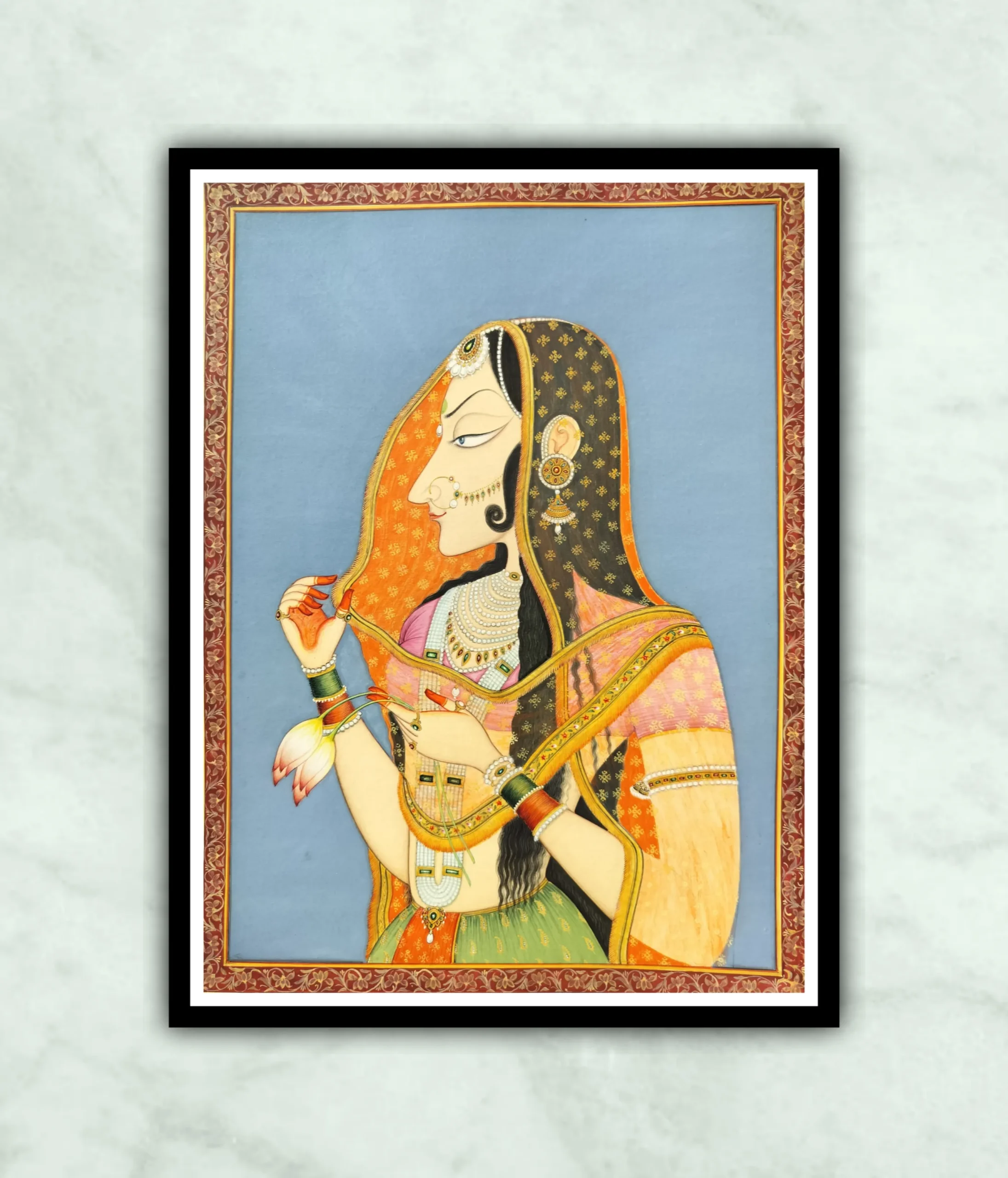
| Artist | Nihal Chand, court painter of Kishangarh |
|---|---|
| Date | Around 1750 (mid-18th century) |
| School | Kishangarh school of Rajasthani (Rajput) miniature painting |
| Patron | Raja Sawant Singh of Kishangarh, a poet who wrote as Nagari Das |
| Subject | Bani Thani, a singer and poet of the court, often seen as an ideal of Radha |
| Known as | The “Indian Mona Lisa” |
Who was Bani Thani?
Bani Thani was a gifted singer and poet at the court of Kishangarh, a small Rajput kingdom near Ajmer in Rajasthan. The name roughly means “the one who is beautifully dressed and adorned”. Raja Sawant Singh, himself a devoted follower of Krishna and a poet under the name Nagari Das, admired her deeply, and their story came to be compared with the divine love of Radha and Krishna.
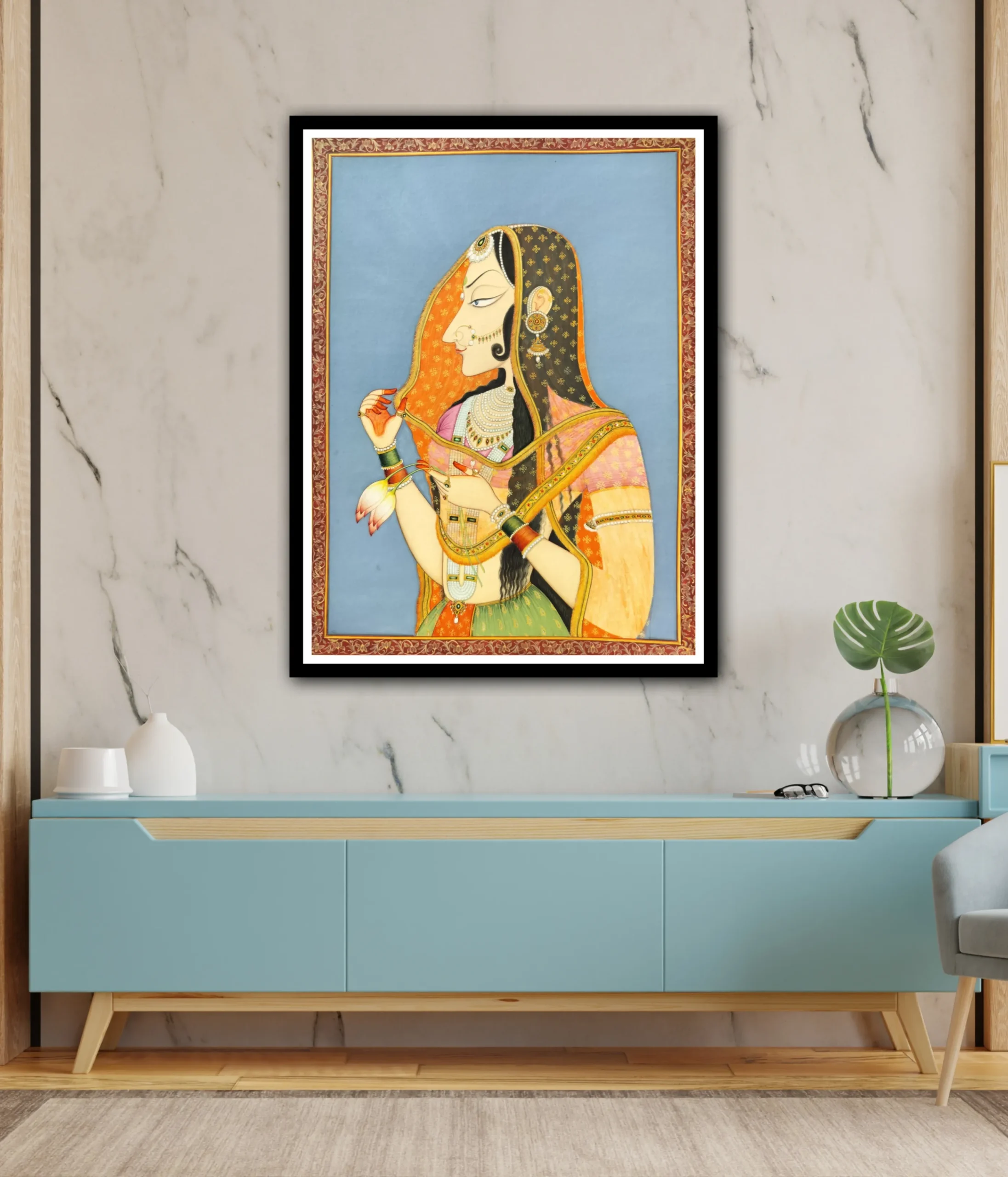
Under Sawant Singh’s patronage, Nihal Chand painted Radha and Krishna with features inspired by this idealised beauty. Over time the face of Bani Thani and the face of Radha in Kishangarh painting became almost the same.
Why is Bani Thani called the “Mona Lisa of India”?
Like Leonardo da Vinci’s Mona Lisa, Bani Thani is a single, unforgettable portrait of a woman whose expression feels calm and slightly mysterious, and whose identity has become part of the painting’s legend. Art historians who studied Kishangarh painting in the 20th century popularised the comparison, and in 1973 India Post honoured the painting on a postage stamp, which made the image famous across the country.
How to recognise the Kishangarh style
Bani Thani set the template for Kishangarh painting. When you look at a Kishangarh work, look for:

- Elongated, lotus-shaped eyes that curve upwards towards the temple.
- A sharp, pointed nose and chin in a clean profile.
- Arched eyebrows and thin, delicate lips.
- A long, curling lock of hair falling beside the cheek.
- A fine, transparent veil (odhni) with gold borders over the head.
- Graceful, slender figures and, in larger works, dreamy lake and garden landscapes.
These features make Kishangarh one of the most elegant schools within Rajasthani paintings. To see how it compares with other regional schools, read our guide to the types of Indian paintings.
Bani Thani and Radha
In many Kishangarh paintings, Radha is drawn with Bani Thani’s face, and Krishna with the features of Raja Sawant Singh. That is why you will often see Bani Thani style faces in Radha Krishna scenes. If you love this devotional side of the style, explore our hand-painted Radha Krishna paintings, including works in Kishangarh style.

Can you buy an original Bani Thani painting?
The original 18th-century Bani Thani is a historic artwork held in collections and is not for sale. What you can own is a hand-painted recreation made with the same traditional techniques. A good recreation is very different from a printed poster:
- It is painted by hand with fine brushes, so you can see delicate individual brush lines in the hair, eyes and jewellery.
- Traditional works use stone and mineral colours, often with real gold for borders and ornaments.
- Colours have depth and a soft glow, rather than the flat dot pattern of a print.
At Artshaili, our artists paint the Bani Thani painting in Kishangarh Shaili entirely by hand, using stone colours and real gold. Each piece is unique and comes unframed, with framing available on request.
Where to place a Bani Thani painting at home
Bani Thani works beautifully as a focal point in a living room, a reading corner or an entrance, where its fine detail can be seen up close. Because the painting is small and intricate, hang it at eye level with soft lighting, and avoid direct sunlight, which can fade traditional colours over time. For more ideas, see our guide to the best paintings for the living room.
Nihal Chand: the artist behind Bani Thani
Nihal Chand was the leading painter at the Kishangarh court in the mid-18th century. Trained in a workshop that knew Mughal techniques, he combined Mughal precision with a completely new ideal of beauty: tall, slender figures, long necks, sharply arched brows and eyes shaped like lotus petals that curve towards the temples. His paintings are full of soft green landscapes, lakes, pavilions and boats, and they feel more like poetry than portraiture.
Nihal Chand did not work in isolation. He painted for a patron who was himself a poet, and many of his works illustrate verses about Radha and Krishna. That close partnership between poet-king and painter is a big reason why Kishangarh art has such a dreamy, romantic mood.
Raja Sawant Singh (Nagari Das): poet, devotee and patron
Raja Sawant Singh of Kishangarh was a devoted follower of Krishna in the Vallabha tradition and wrote devotional poetry under the pen name Nagari Das. In his later years he turned away from courtly life and spent time in Vrindavan, Krishna’s sacred town. His love for Bani Thani, and his poems about Radha and Krishna, shaped the themes that Nihal Chand painted. Many art historians see the Kishangarh style as a visual form of his poetry.
Bani Thani and the Mona Lisa compared
| Bani Thani | Mona Lisa | |
|---|---|---|
| Artist | Nihal Chand | Leonardo da Vinci |
| Period | Around 1750, India | Early 1500s, Italy |
| Style | Kishangarh miniature painting | Italian Renaissance oil painting |
| Medium | Mineral colours and gold on paper | Oil on poplar wood panel |
| What makes it famous | Idealised beauty: lotus eyes, sharp profile, graceful veil | Mysterious smile and soft sfumato shading |
Read more about the European masterpiece in our article on the secrets of the Mona Lisa painting.
Materials and techniques of Kishangarh painting
A traditional Kishangarh miniature such as Bani Thani is built up slowly, layer by layer:
- Preparing the surface: handmade paper is layered and polished smooth so fine lines do not bleed.
- The drawing: the artist sketches the composition, then refines the face and outlines with a very fine brush.
- Colour layers: stone and mineral colours, ground by hand and mixed with a natural binder, are applied in thin coats. Each layer is burnished so the surface becomes smooth and luminous.
- Gold and details: real gold is used for jewellery, borders and the veil’s edging, and the finest brushes add eyelashes, hair and ornaments.
- Finishing: borders and decorative frames complete the painting.
This is why a hand-painted Bani Thani takes much longer to create than a print, and why the colours have a soft glow that you can only see in person.
Identifying a genuine hand-painted Bani Thani
- Hair-fine lines in the eyelashes, the curl of hair by the cheek and the edges of jewellery.
- Slight unevenness in colour and texture that comes from layered stone pigments.
- Real gold that catches the light differently from yellow paint.
- No printed dot pattern when you look closely with a magnifying glass.
- Clear information about size, colours and the artist from the seller.
Choosing the right size and frame
Bani Thani paintings are traditionally small and intimate. A piece around 13 x 9 inches, like our hand-painted Bani Thani, works beautifully on its own above a console or desk, or as the centre of a small gallery wall with other Rajasthani paintings. Choose a frame with a wide mount (mat) and glass to protect the surface, and a warm wood or antique gold moulding to suit the colours. Our paintings come unframed, and framing is available on request.
Bani Thani as a gift
As a symbol of grace, devotion and love, a Bani Thani painting is a meaningful gift for weddings, anniversaries, housewarmings and art lovers. Because each piece is painted by hand, the gift is genuinely one of a kind. For more gift ideas, explore our Radha Krishna paintings and Indian miniature paintings.
Timeline of Kishangarh painting
| Period | What happened |
|---|---|
| Early 17th century | The Rajput kingdom of Kishangarh is founded near Ajmer in Rajasthan. |
| Late 17th to early 18th century | The court workshop absorbs Mughal techniques of fine line and naturalism. |
| Mid-18th century | Under Raja Sawant Singh, Nihal Chand creates the distinctive Kishangarh ideal and paints Bani Thani (around 1750). |
| Later 18th and 19th centuries | Kishangarh painters continue the style, repeating the elongated faces and lake landscapes. |
| 20th century | Art historians bring Kishangarh painting to wide attention; India Post issues the Bani Thani stamp in 1973. |
| Today | Traditional artists keep the style alive with hand-painted works in stone colours and gold. |
Glossary: words you will meet in Kishangarh art
- Shaili: style or school of painting, as in Kishangarh shaili.
- Nayika: the heroine of Indian love poetry, often painted waiting for or meeting her beloved.
- Odhni: the veil or scarf draped over the head, painted almost transparent in Bani Thani.
- Stone colours: pigments ground from minerals and stones, used for their depth and permanence.
- Burnishing: polishing the painted surface with a smooth stone to give it a soft shine.
- Vallabha (Pushtimarg) tradition: a Krishna devotional tradition followed by Raja Sawant Singh, which shaped the themes of Kishangarh painting.
Frequently asked questions
Bani Thani was painted by Nihal Chand, the leading artist at the court of Kishangarh in Rajasthan, around 1750.
It belongs to the Kishangarh school, one of the Rajasthani (Rajput) schools of Indian miniature painting.
It roughly means “the well-dressed, adorned lady”, a reference to her elegance.
Its idealised beauty, with long curved eyes and a sharp profile, defined the Kishangarh style and became an icon of Indian art. It is often called the Mona Lisa of India and appeared on an Indian postage stamp in 1973.
Not literally, but in Kishangarh painting Radha is often painted with Bani Thani’s features, so the two images are closely linked.
Nihal Chand was the leading painter at the Kishangarh court in the mid-18th century and the artist of the famous Bani Thani painting.
Elongated faces, lotus-shaped eyes, sharp profiles, slender figures and dreamy lake landscapes, often showing Radha and Krishna.
Frame it behind glass with a wide mount, keep it away from direct sunlight and damp walls, and dust only the frame with a soft dry cloth.
